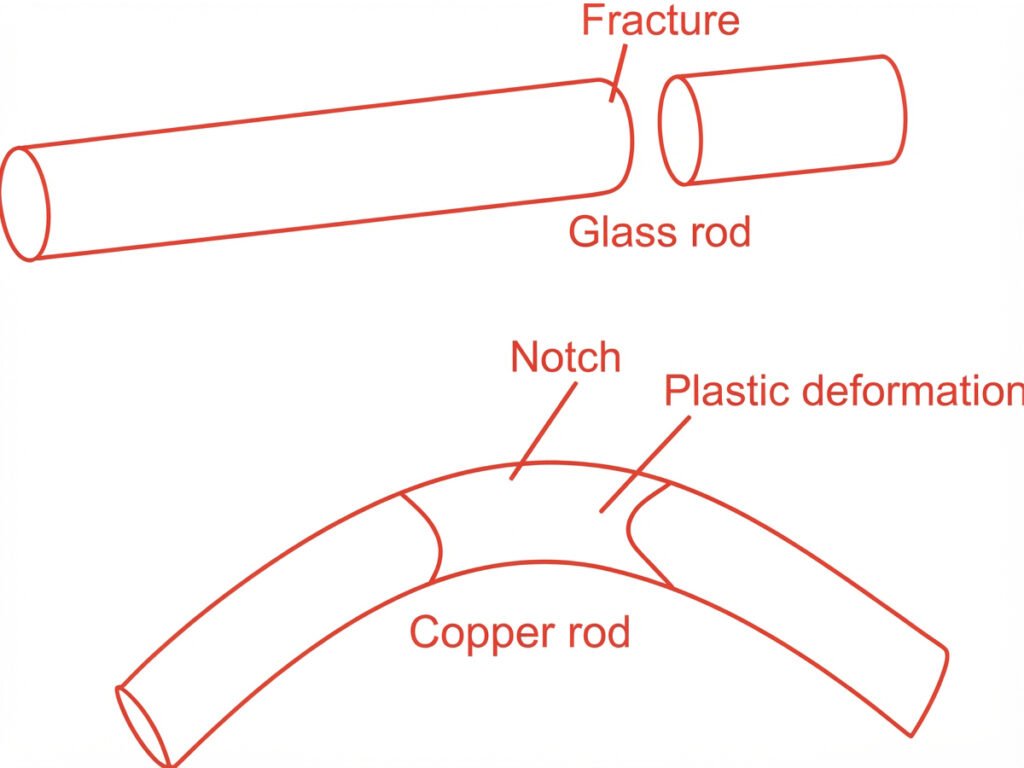
Pull a copper wire and it stretches noticeably before breaking; strike a glass rod and it shatters almost instantly. Both are solids, yet they respond to force very differently. This difference is closely related to a key mechanical property: ductility.
What Is Ductility?
Ductility is the ability of a material to undergo substantial plastic deformation under tensile stress before fracturing. A ductile material can permanently stretch or thin before breaking, often showing visible deformation before failure. Materials that fracture without significant plastic deformation are brittle.
Although the term can apply to any solid, ductility is most commonly used to describe metals. Copper, aluminum, gold, and mild steel are classic examples: they can be drawn into wires or formed into complex shapes without fracturing easily. This behavior is closely tied to the nature of metallic bonding, which allows atoms to shift past one another without the material falling apart.
Ductility in Non-Metallic Materials
Outside of metals, ductility is discussed less often and depends more strongly on the material and test conditions.
- Polymers: Many polymers, such as polyethylene and nylon, can stretch considerably before breaking and may thin into a narrow “neck” as they deform. However, this behavior depends strongly on temperature and loading rate, and the same polymer may become brittle when cooled sufficiently.
- Ceramics and glass: Rigid ionic and covalent bonds generally resist atomic slip, so these materials are brittle at room temperature. Some can undergo substantial deformation at elevated temperatures.
- Composites: Their ductility depends on the matrix, reinforcement, and interface. A tougher or more ductile matrix can improve overall deformability, but many composites remain less ductile than conventional metals.
Why Material Ductility Matters
Ductility affects both how safely a structure behaves and how easily a material can be shaped, making it an important consideration in engineering.
Warning Before Failure
Ductile materials deform visibly before they break. A sagging beam or stretched cable can signal trouble and leave time for repair, whereas brittle fracture can occur suddenly with little warning.
Energy Absorption
By deforming plastically, ductile materials absorb energy from impacts, earthquakes, and accidental overloads. Local yielding also spreads stress to neighboring regions, helping a structure withstand loads beyond its design assumptions.
Tolerance of Stress Concentrations
Holes, notches, and small flaws concentrate stress. In ductile materials, local yielding can blunt these peaks and slow crack growth.
Ease of Manufacturing
Many forming processes require a material to deform without fracturing. Wire drawing, rolling, bending, and deep drawing all depend on adequate ductility, allowing metals to be shaped into products such as cables and car body panels.
How Ductility Is Measured and Calculated
Ductility is measured by pulling a specimen until it breaks and is commonly expressed as a percentage based on changes in its dimensions.
Measurement
- Prepare the specimen. A standardized sample is machined, and two marks are made along its length to define the original gauge length (L₀).
- Load the sample. The specimen is gripped in a universal testing machine and pulled at a controlled rate.
- Test to fracture. The machine records load and elongation until the specimen breaks.
- Measure after fracture. The broken pieces are fitted back together to measure the final gauge length (Lᶠ) and the smallest cross-sectional area at the break (Aᶠ).
Calculation
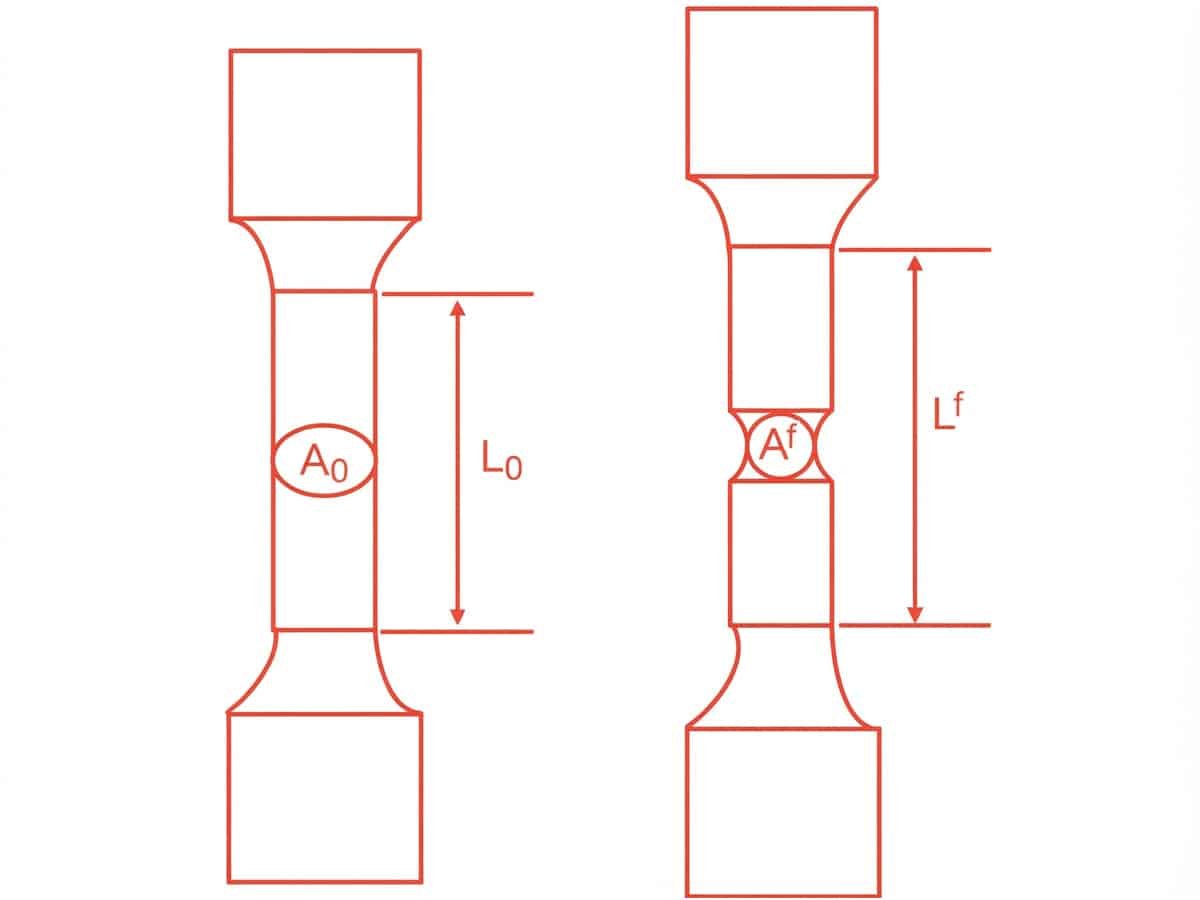
Percent elongation compares the change in gauge length with the original length:
%EL = (Lᶠ − L₀) / L₀ × 100
Percent reduction in area compares the change in cross-sectional area at the fracture point with the original area (A₀):
%RA = (A₀ − Aᶠ) / A₀ × 100
For example, a specimen with L₀ = 50 mm that stretches to Lᶠ = 60 mm has %EL = 20%. Higher values generally indicate greater ductility. Because elongation depends on gauge length, it should always be reported together with L₀.
Factors That Influence Material Ductility
Ductility is not a fixed property. It changes with the conditions of use and with how the material was made and processed. Several factors are especially important.
Temperature
Lower temperatures generally reduce ductility. Many steels undergo a ductile-to-brittle transition as they cool, while higher temperatures usually make metals more ductile.
Strain Rate
Rapid loading gives atoms less time to rearrange, so a material that is ductile under slow loading may fracture in a brittle way under impact.
Composition and Impurities
Alloying elements can increase strength at the expense of ductility. For example, increasing carbon content makes steel harder but less ductile. Impurities such as sulfur and phosphorus can further promote brittle fracture.
Microstructure and Processing
Fine grains can improve ductility, while annealing can restore ductility by relieving the effects of prior processing. Cold working does the opposite: it strengthens the metal but reduces its ductility.
Stress State and Environment
Notches and thick sections can restrict plastic flow and encourage brittle fracture. Corrosive or hydrogen-rich environments can also embrittle metals.
Ductility of Common Materials
The table below compares typical elongation at break (%EL) for several common materials. Values are approximate and vary with composition, processing, test method, and temperature.
| Material | Typical %EL | General Ductility |
|---|---|---|
| Gold (annealed) | 40-50% | High |
| Copper (annealed) | 45-55% | High |
| Stainless steel 304 (annealed) | 40-60% | High |
| Aluminum (pure, annealed) | 35-45% | High |
| Mild steel | 20-30% | Moderate to high |
| Gray cast iron | Below 1% | Very low (brittle) |
| Glass and alumina ceramic | About 0% | Brittle |
| High-density polyethylene (HDPE) | 100-1000% | Very high |
Polymer values are not directly comparable with metals because polymers are tested under different conditions and their elongation is highly sensitive to temperature and loading rate.
Selecting Materials Based on Ductility
Choosing a material means balancing ductility with other requirements such as material hardness, cost, and weight. The following considerations can guide that decision.
Consider Service Conditions
Check the lowest operating temperature and the loading rate. Some steels can become brittle in the cold or under impact, while aluminum and austenitic stainless steels generally retain good ductility at low temperatures.
Balance Ductility with Strength
Strength and ductility often trade off. Select a grade that provides sufficient strength for the expected loads while maintaining adequate elongation for the application.
Account for Manufacturing
Parts that will be drawn, bent, or stamped need enough ductility to be formed without cracking, and annealing between steps can restore ductility when needed.
Confirm with Standards and Testing
Design codes typically specify minimum elongation for structural materials. Tensile tests, together with impact tests where relevant, can verify that a chosen material or batch meets the required specifications.
Conclusion
Ductility is vital to both safety and manufacturability, but as this guide has shown, its measured value and suitability depend heavily on material grade and processing conditions. Choosing the right material takes more than typical values. For tailored guidance, explore Zhongde’s Material Selection Service.