Plastic parts often require additional assembly steps after molding—brackets need to be attached to housings, membranes must create reliable seals, and multiple molded components need to become a single functional assembly.
Ultrasonic welding provides a simple and reliable way to join thermoplastic components without screws, adhesives, or other fasteners. With fast cycle times and consistent bonding quality, it has become a common joining method for many plastic applications.
What Is Ultrasonic Plastic Welding?
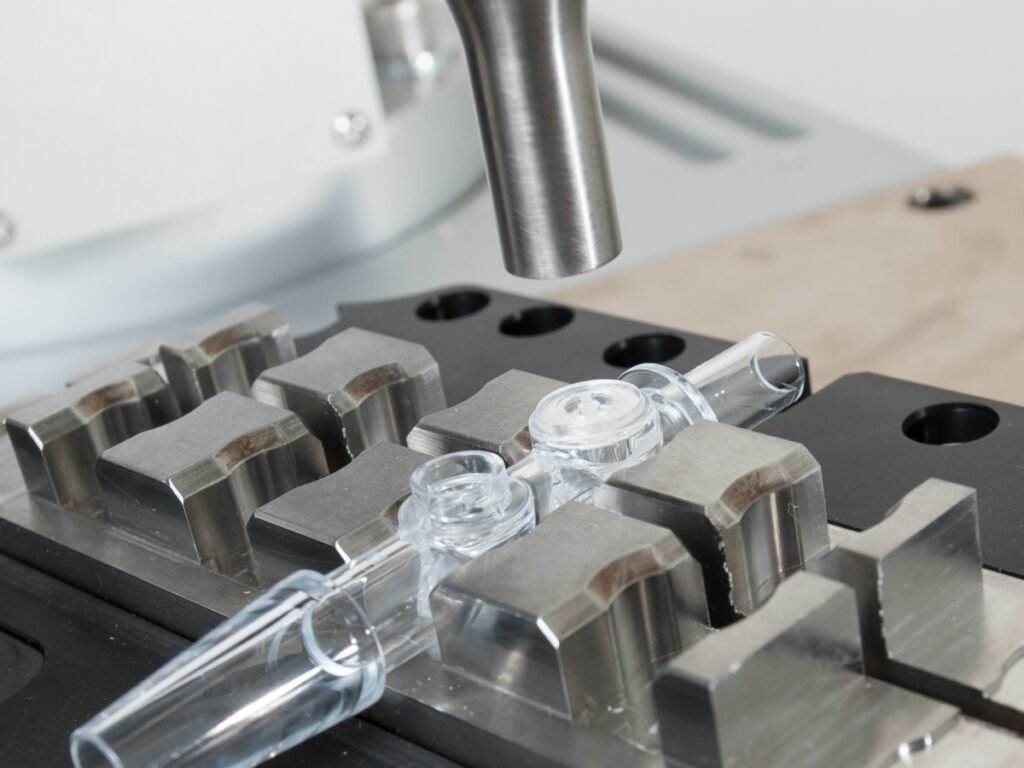
Ultrasonic welding is a joining process that uses high-frequency vibrations to bond thermoplastic parts together. During the process, a welding horn (sonotrode) applies ultrasonic vibrations and pressure to the joint area, generating heat that melts the plastic at the interface. After the vibration stops, the material cools and solidifies, creating a permanent bond.
The entire process usually takes less than one second, making ultrasonic welding ideal for high-volume production. Since the process melts and fuses the base material itself instead of using adhesives or additional fasteners, the weld strength can be comparable to the surrounding plastic when the joint is properly designed.
How Does Ultrasonic Plastic Welding Work?
The ultrasonic welding cycle consists of four basic steps:
- Part Fixturing: The two plastic components are positioned together in a nest (fixture) that keeps them aligned and prevents movement during welding.
- Horn Contact and Pressure: The welding horn descends and applies controlled pressure to clamp the components firmly against the fixture.
- Ultrasonic Vibration: The horn vibrates at the preset frequency for a short duration (often 0.1–1 second). The vibration is concentrated at the joint interface, often through a design feature called an energy director, where friction and molecular movement generate enough heat to melt the plastic locally.
- Hold and Solidification: After vibration stops, pressure is maintained for a short hold time while the molten plastic cools and solidifies, creating a strong weld joint. The horn then retracts, and the assembled part is removed.
The entire sequence is usually automated, with weld time, pressure, and amplitude controlled as fixed parameters to ensure consistent results from cycle to cycle.
When to Use Ultrasonic Plastic Welding
Not every plastic assembly is suitable for ultrasonic welding. Selecting the right joining method depends on the material compatibility, joint design, production volume, and performance requirements of the final part.
Compatible Thermoplastic Materials
Both parts should be made from compatible thermoplastics, ideally the same resin or materials with similar welding characteristics. ABS, polycarbonate, nylon, and polypropylene are commonly used materials. Dissimilar plastics, such as PP and ABS, are generally more challenging to weld and may require special material combinations or process optimization.
Small to Medium-Sized Parts
Ultrasonic welding works best when the horn can transfer vibration evenly across the joint area. It is typically used for small to medium-sized components with a weld area that allows efficient energy transfer. Larger parts may require multiple horns or alternative processes such as vibration welding.
High-Volume Production
With cycle times often under one second and easy automation capabilities, ultrasonic welding is well suited for applications requiring thousands or millions of repeatable weld cycles, including automotive components, medical device housings, and consumer electronics.
Joints Requiring a Hermetic or Structural Seal
When a joint needs to be airtight, watertight, or capable of bearing mechanical load—such as filter housings, fluid reservoirs, or enclosure seals—ultrasonic welding can produce bonds that approach the strength of the base material itself.
Assemblies Where Cleanliness Matters
Because the process requires no adhesives, solvents, or additional hardware, it is widely used for medical devices, food packaging, and electronics where contamination and particulate residue must be minimized.
Ultrasonic Plastic Welding Design Considerations
Weld quality depends not only on the welding equipment but also on how the plastic parts are designed. Several design factors should be considered before production begins.
Joint Design
The joint interface should be designed to concentrate ultrasonic energy at a specific location instead of allowing it to spread across a large contact area. A common approach is the energy director—a small triangular ridge molded onto one mating surface—which melts first and focuses heat generation at the intended weld location. For applications requiring hermetic sealing or higher resistance to separation forces, a shear joint design, where the two surfaces overlap along a vertical wall, is often preferred.
Wall Thickness and Rigidity
Uniform wall thickness helps transmit ultrasonic energy more consistently through the part. Thin or unsupported walls may flex, absorb energy, or vibrate uncontrollably, reducing weld efficiency and potentially causing stress whitening or cracks away from the weld area. Ribs and gussets can improve rigidity without adding unnecessary material.
Part Alignment Features
Since the two components must remain accurately positioned throughout the weld cycle, alignment features such as locating pins, tongue-and-groove interfaces, or step joints help prevent lateral movement during vibration and ensure consistent contact between the energy director and mating surface.
Material Selection and Compatibility
Beyond basic thermoplastic compatibility, factors such as filler content, regrind ratio, and moisture absorption can affect how consistently a material melts and flows during welding. Materials containing glass fiber or mineral fillers, for example, may require higher energy input and can reduce weld consistency by changing melt behavior and energy transmission.
Flash and Debris Control
The molten plastic squeezed out during welding, known as flash, can affect appearance or function if not properly managed. Features such as flash traps—small recessed channels near the joint—can capture excess material and prevent it from appearing on external surfaces or interfering with moving components.
Proper welding design is only one part of creating a functional plastic assembly. Learn more about plastic parts assembly to explore other joining methods and integration options.
Conclusion
Ultrasonic welding is a reliable joining method for thermoplastic parts when material selection, joint design, and process parameters are properly considered. If you need custom plastic parts designed for ultrasonic welding, Zhongde can support your project from material selection and injection molding to assembly requirements.
Need Plastic Parts for Ultrasonic Welding?
Choosing the right material and manufacturing process is essential for reliable ultrasonic welding. At Zhongde, we will help you develop and produce thermoplastic components with the support you need:
- Recommend suitable materials for your application
- Optimize molding processes for consistent part quality
- Support ultrasonic welding and plastic assembly requirements