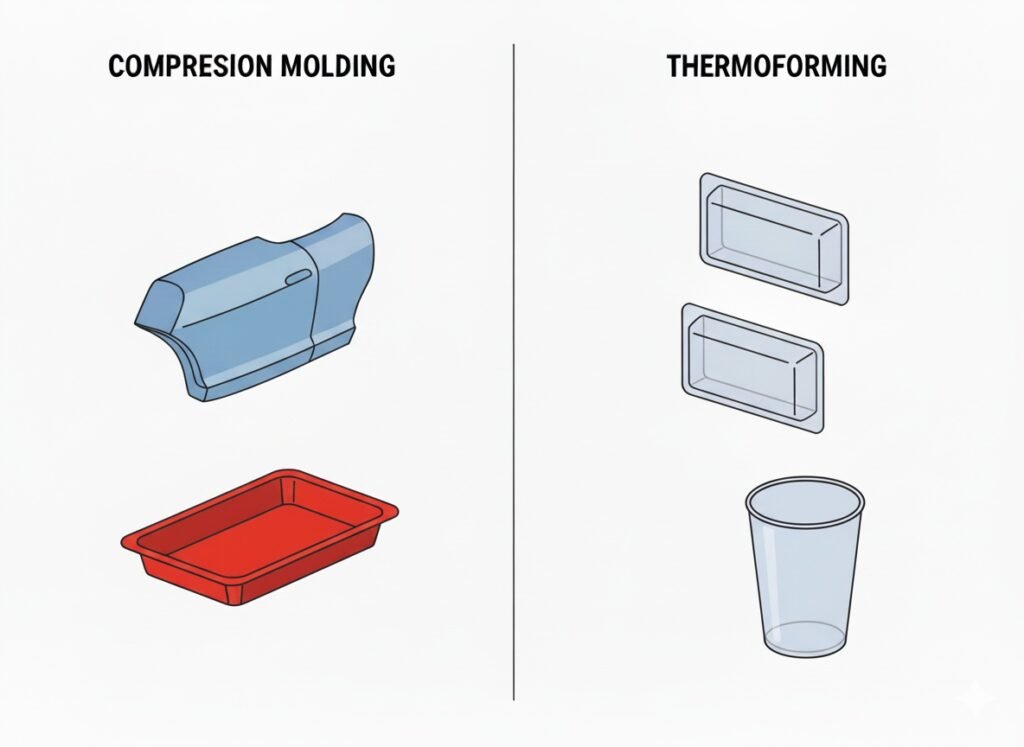
When you’re choosing a manufacturing process for plastic parts, two common options often come up: compression molding and thermoforming. At first glance, they may look similar—both use heat and pressure to shape materials—but the way they form parts, the type of products they suit, and the level of detail they can achieve are quite different.
Understanding these differences can help you quickly decide which process fits your product better before moving into detailed design or tooling decisions.
What Is Compression Molding?
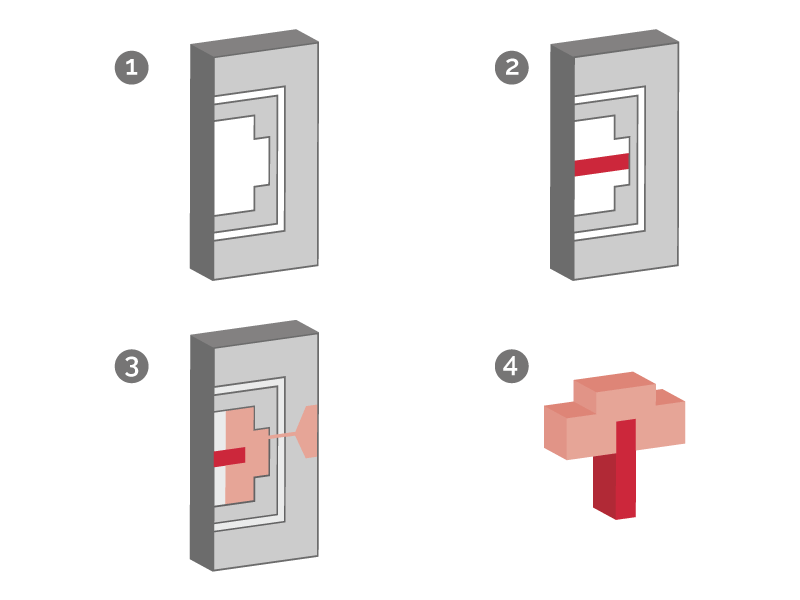
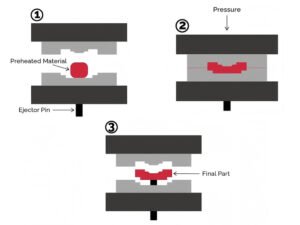
Compression molding is a process where a preheated material is placed into an open heated mold, and then the mold is closed under pressure to force the material to fill the cavity and take shape.
In simple terms, the material is pressed directly into the mold rather than injected or stretched. It softens under heat, flows under pressure, and solidifies while the mold is held closed.
After a set curing or cooling time, the mold is opened and the finished part is removed. This process is commonly used for thermoset plastics and reinforced materials, especially for parts that require strength and stability.
Advantages of Compression Molding
Compression molding is well suited for producing parts with good structural strength. Because the material is pressed under high pressure and often fully cured inside the mold, the final parts tend to have solid internal density and stable mechanical performance.
It is also relatively efficient for thicker or larger parts. Compared with processes that rely on flow through narrow channels, compression molding places the material closer to its final shape from the beginning, which reduces flow-related defects such as weld lines or flow marks.
Another advantage is tooling simplicity. In many cases, compression molds are less complex than injection molds, which can make initial tooling more cost-effective, especially for simpler geometries and lower production volumes.
Disadvantages of Compression Molding
At the same time, compression molding is less suitable for highly detailed or intricate designs. Since the material is not injected into every fine feature under controlled flow, achieving sharp edges or complex internal structures can be more difficult.
Cycle times are also generally longer. The process requires heating, pressing, and curing or cooling under pressure, which can limit production efficiency compared to faster molding methods.
In addition, dimensional accuracy and surface consistency may be more difficult to control, especially for parts with uneven thickness or tight tolerance requirements. This makes the process less ideal for precision components or highly aesthetic products.
What Is Thermoforming?
Thermoforming is a manufacturing process where a plastic sheet is heated until it becomes soft and flexible, then formed over a mold using vacuum, pressure, or mechanical force.
In simple terms, it starts with a flat sheet of plastic. Once heated, the sheet is stretched and shaped to match the surface of a mold, then cooled until it retains the new form.
After forming and cooling, the excess material is trimmed away to produce the final part. This process is commonly used for packaging, enclosures, and large, relatively thin-walled plastic components.

Advantages of Thermoforming
Thermoforming is widely used because it is fast, flexible, and cost-efficient for many types of plastic parts, especially those with simpler geometry and larger surface areas.
One of its main advantages is low tooling cost. Compared with injection or compression molding, thermoforming molds are generally simpler and less expensive to produce. This makes the process attractive for low to medium production volumes or early-stage product development.
It also offers short lead times. Since the process starts with plastic sheets rather than complex injection systems, tooling and setup can be completed relatively quickly, allowing faster prototyping and product iteration.
Another benefit is design flexibility for large parts. Thermoforming is particularly effective for producing wide, thin-walled components such as trays, panels, and housings. It can cover large surface areas without requiring high injection pressure or complex runner systems.
Disadvantages of Thermoforming
While thermoforming is efficient and cost-effective, it also has clear limitations that make it less suitable for certain types of parts and performance requirements.
One key limitation is lower structural strength compared to molding processes like injection or compression molding. Because thermoforming starts from a heated sheet that is stretched over a mold, the material distribution can become uneven, especially in deeper or more complex shapes.
It also has limited design complexity. Deep undercuts, sharp internal features, and highly detailed geometries are difficult to achieve because the sheet must be formed over a single surface direction. This restricts the level of detail that can be achieved in the final part.
Differences Between Compression Molding vs Thermoforming
Now that we have looked at both processes individually, the next step is to understand how these differences affect real manufacturing decisions. The differences can be better understood by breaking them down into several key technical dimensions.
Material Type
Compression molding is commonly used with thermoset materials and reinforced compounds. These materials undergo curing under heat and pressure, which means the final part is formed through a chemical or structural change rather than just cooling. This is one reason compression molding is often chosen for parts that require high strength and long-term stability.
Thermoforming, in contrast, is mainly used with thermoplastic sheets. The material is repeatedly heat-softened and reshaped without undergoing a chemical transformation. This makes thermoforming more suitable for applications where recyclability, fast forming, and low-cost production are important.
Forming Mechanism
In compression molding, high pressure is applied as the mold closes, forcing the material to fully conform to the cavity. This results in dense, solid parts with relatively strong internal structure.
Thermoforming relies mainly on vacuum, air pressure, or mechanical force to pull or push the softened sheet against the mold surface. The pressure is generally lower, which limits how tightly the material can fill detailed features.
Design Complexity and Detail
Compression molding is better suited for thicker, more solid parts with moderate complexity. It can handle more three-dimensional shapes compared to sheet-based forming.
Thermoforming is more limited to relatively shallow, open, or large surface-area parts. Deep undercuts and intricate internal structures are difficult to achieve due to the nature of sheet stretching.
Surface Quality and Dimensional Control
Compression molding generally provides more uniform material distribution and better structural consistency, especially for thicker components.
Thermoforming can experience uneven wall thickness due to material stretching, which may affect both mechanical strength and surface consistency, particularly in deeper formed areas.
Tooling and Production Efficiency
Compression molding typically requires more robust tooling and longer cycle times due to heating, pressing, and curing or cooling stages.
Thermoforming uses simpler molds and usually has faster tooling development and lower upfront cost, making it more suitable for rapid production and prototyping.
Typical Applications
Compression molding is commonly used for automotive structural parts, electrical components, and reinforced plastic products.
Thermoforming is widely used for packaging, trays, housings, and large surface-area products where speed and cost are priorities.
Conclusion
Compression molding and thermoforming are both useful shaping processes, but they are built on different materials and working principles.
If you want to explore the processes in more detail, you can also read our guide on the compression molding process and thermoforming process to better understand how each method works in practice. For projects that require production support, Zhongde provides compression molding service to help turn your design into stable, manufacturable parts.