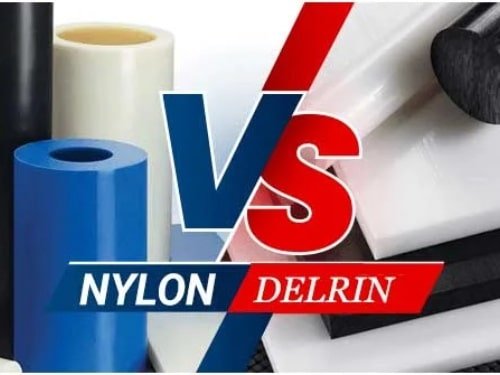
Choosing the right engineering plastic can make a big difference in the performance and longevity of your parts. Among the most commonly used options, Delrin (also known as acetal) and Nylon (polyamide) are often compared because they both offer excellent strength, wear resistance, and machinability—but they behave quite differently in real-world applications.
In this guide, we’ll explore the key differences between Delrin and Nylon, from mechanical properties to environmental sensitivity, and help you understand which material is better suited for your specific project needs.
What Is Delrin?
Delrin is a trade name commonly used for polyoxymethylene (POM), an engineering thermoplastic known for its high stiffness, low friction, and excellent dimensional stability. It is widely used in precision mechanical parts where consistent performance and tight tolerances are required.
The name “Delrin” was originally introduced by DuPont, the company that first commercialized this grade of acetal homopolymer. Over time, “Delrin” has become a common industry term, although it technically refers to a specific type of POM rather than all acetal materials.
Delrin comes in several grades, each tailored for different mechanical or processing requirements. Common types include:
- Delrin 150 – Standard homopolymer grade with balanced strength and stiffness
- Delrin 507 – Modified for improved impact resistance
- Delrin 500P – High-performance grade with enhanced thermal stability
- Delrin AF – Lubricated grade for reduced friction and wear
What Is Nylon?
Nylon, also known as polyamide (PA), is a versatile engineering thermoplastic widely used for its excellent strength, toughness, and abrasion resistance. It was first developed in the 1930s and quickly became popular for industrial and consumer applications due to its durability and ability to withstand repeated mechanical stress.
Nylon is available in several types, each designed for specific performance requirements:
- Nylon 6 (PA6) – Commonly used for general-purpose components with good balance of strength and flexibility
- Nylon 6/6 (PA66) – Offers higher mechanical strength and heat resistance compared to PA6
- Nylon 12 (PA12) – Low moisture absorption and good chemical resistance, suitable for precision parts
- Glass-Filled Nylon – Reinforced with glass fibers for increased stiffness and dimensional stability
Delrin vs Nylon: Key Performance Comparison
Delrin and Nylon are both widely used engineering plastics, and at first glance they may seem similar—both are strong, machinable, and suitable for mechanical parts. But once you look deeper into how they behave under different conditions, the differences become much more practical and application-driven.
So how do they actually compare when it comes to real engineering requirements?
Tensile Strength and Rigidity
If you imagine a part that must stay perfectly in shape under load, Delrin often feels more “solid” and predictable. It has higher stiffness, which means it resists bending and deformation more effectively.
Nylon, on the other hand, is tougher and slightly more flexible. It can absorb stress instead of resisting it rigidly. So if Delrin is like a firm metal ruler, Nylon behaves more like a tough spring that can bend slightly and still recover.
Moisture Absorption and Dimensional Stability
If a part changes size after being exposed to humidity, even slightly, it can affect assembly fit.
Delrin absorbs very little moisture, which helps it maintain stable dimensions in different environments. This is one reason it is often chosen for precision parts where tight tolerances matter.
Nylon absorbs more moisture from the environment. While this improves toughness in some cases, it can also cause small dimensional changes. In practical terms, a Nylon part stored in a humid environment may not behave exactly the same as one in a dry workshop.
Wear Resistance and Friction Behavior
Delrin is well known for its low friction surface, which makes it ideal for moving parts like gears, bushings, or sliding mechanisms. It tends to run smoothly without additional lubrication.
Nylon also performs well in wear applications, but it absorbs moisture more easily, which can slightly change its friction and dimensional behavior over time. In dry environments, Nylon can perform very well, but conditions matter more compared to Delrin.
3D Printing Capability
When it comes to 3D printing, Nylon is much more commonly used than Delrin. Nylon powders and filaments are widely available for processes like SLS and FDM, making it a popular choice for functional prototypes and flexible parts.
Delrin, however, is rarely used in standard 3D printing due to its high crystallinity and processing difficulty. This makes it less suitable for most additive manufacturing setups.
Machinability and Processing
From a manufacturing perspective, Delrin is often easier to machine. It produces clean edges and maintains dimensional accuracy well after cutting, which is why it is popular in CNC machining projects.
Nylon is also machinable, but it is more sensitive to heat buildup during processing. If conditions are not controlled properly, it can deform slightly due to its softer nature.
Pros and Cons of Delrin vs Nylon
After comparing their performance in different aspects, it becomes clearer that both Delrin and Nylon have their own strengths and limitations. Instead of asking which one is “better,” it is more practical to understand what each material does well—and where it may fall short.
Delrin (POM)
Pros:
- Excellent dimensional stability with minimal moisture absorption
- High stiffness and good load-bearing capability
- Very low friction, suitable for moving and sliding parts
- Easy to machine with clean cutting performance
- Consistent performance in humid environments
Cons:
- Lower impact resistance compared to Nylon
- More limited flexibility under sudden load
- Poor compatibility with strong acids and certain chemicals
- Difficult to use in 3D printing applications
Nylon (PA)
Pros:
- High toughness and excellent impact resistance
- Good wear resistance in dynamic applications
- More flexible under mechanical stress
- Suitable for 3D printing and prototyping applications
- Strong performance in load-bearing functional parts
Cons:
- Absorbs moisture, which can affect dimensions over time
- Can deform slightly under long-term load
- Friction properties vary depending on humidity conditions
- More sensitive to machining heat buildup
Applications of Delrin and Nylon
Understanding where Delrin and Nylon excel in real-world use can make the material selection process much more intuitive. Let’s look at typical applications for each, while highlighting why each material works well in those scenarios.
Delrin Applications
Delrin is widely used in precision mechanical systems where parts need to move smoothly and maintain tight dimensional control over time. Its low friction and high stability make it especially suitable for components involved in repeated motion or alignment functions.
You will often find Delrin used in:
- Gears and Bushings – Small but critical components inside machines, where smooth rotation and low wear are essential for long-term performance.
- Bearings and Rollers – Parts that continuously rotate or slide under load, requiring consistent shape to avoid vibration or misalignment.
- Precision Machine Components – Spacers, housings, and guides that define how other parts fit and move within an assembly.
- Sliding Mechanisms – Linear guides, drawer slides, and conveyor elements where smooth, low-resistance motion directly affects user experience or system efficiency.
Nylon Applications
Nylon is widely used in structural and functional components that require strength, toughness, and reliable performance under real operating conditions. Its ability to absorb impact and maintain integrity under stress makes it suitable for a wide range of demanding applications.
You will often find Nylon used in:
- Brackets and Mounting Supports – Structural parts that hold components in place, where strength and flexibility help absorb vibration and prevent cracking under load.
- Gears and Sprockets (Heavy-Duty Use) – Mechanical transmission parts where shock resistance and durability under stress are more important than ultra-smooth motion.
- Automotive Components – Clips, fasteners, and engine bay parts that withstand heat, vibration, and long-term mechanical stress.
- Protective and Structural Housings – Covers and enclosures that may experience impact or rough handling during operation or maintenance.
How to Choose Between Delrin vs Nylon
Selecting the right material doesn’t have to feel like guesswork. The best approach is to picture how your part will perform in its actual environment, and let the material properties guide the choice.
Delrin for Precision and Consistency
Think of small moving parts like gears, sliders, or alignment guides. If these parts need to maintain exact positions and smooth motion over thousands of cycles, Delrin is a reliable choice. Its stiffness and dimensional stability ensure parts won’t warp or drift, keeping your assembly accurate over time.
Nylon for Toughness and Impact Resistance
Now imagine components that face vibration, bumps, or repeated mechanical stress—brackets, housings, or clips. Nylon can handle these conditions well thanks to its toughness and flexibility. Even if it bends slightly under impact, it recovers without cracking, making it ideal for parts that must absorb shocks.
Delrin vs Nylon in Cost
From a cost perspective, Nylon is generally more economical in standard grades. Delrin, on the other hand, tends to be more expensive due to its higher dimensional stability and more consistent machining performance.
In practice, this means Delrin is often chosen for key functional components, while Nylon is used more broadly where toughness and cost balance are priorities.
Conclusion
Delrin and Nylon are both widely used engineering plastics, but they behave differently in real applications. One focuses more on maintaining shape and precision, while the other is better suited for absorbing stress and handling impact in everyday use. In most cases, the right choice becomes clearer once you think about how the part will actually behave in its final application.
If you want to learn more about material choices beyond Delrin and Nylon, you can check Common 8 Kinds of Plastic Material.
And if you are still unsure which material is more suitable for your project, or need support in material selection and CNC machining service, Zhongde can help you evaluate your requirements and provide practical manufacturing solutions based on your application needs.
Start A New Project Right Now!