The thermoforming process is one of the most widely used manufacturing methods for producing plastic parts. When you want to get a large plastic part with a low initial setup cost, the thermoforming process will be a good choice. What is the thermoforming process? What are the advantages and limitations? View the blog, and you will make a inform decision.
What Is the Thermoforming Process?
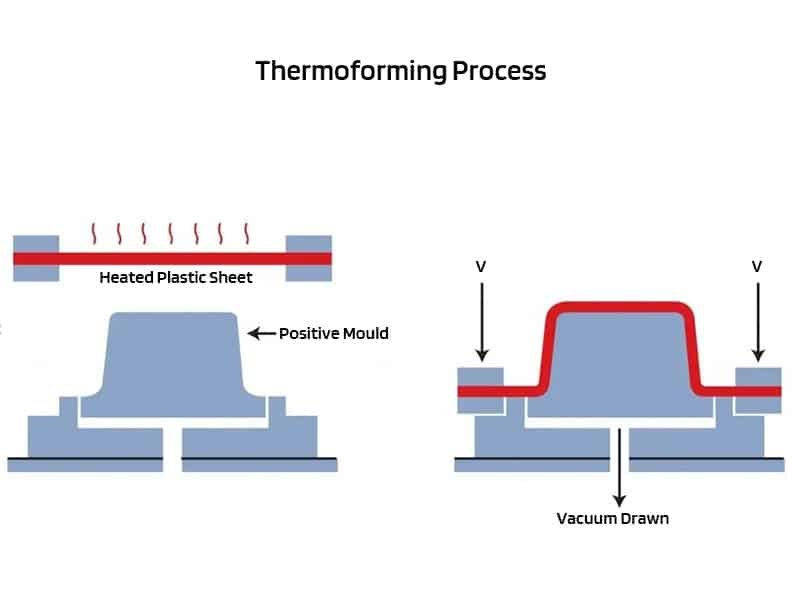
At its core, the thermoforming process involves heating a thermoplastic sheet until it reaches a pliable state, forming it over or into a mold, and then cooling it to retain the desired shape. Once solidified, excess material is trimmed away to produce the final part.
This method is fundamentally different from injection molding. Instead of injecting molten plastic into a closed cavity under high pressure, thermoforming reshapes an already formed sheet. The implication is significant—tooling is simpler, but geometric complexity is inherently limited.
When Should You Choose Thermoforming?
Thermoforming is particularly suitable in scenarios where production volumes are moderate and tooling budgets are constrained. Thermoforming is the ideal process when parts are large but do not require complex internal features.
For rapid prototyping or short lead-time projects, the thermoforming process’s ability to quickly produce functional parts without extensive tooling investment can accelerate product development.
Step-by-Step Thermoforming Process
Heating the Plastic Sheet
The process begins with a flat thermoplastic sheet, which is uniformly heated to a specific temperature range where it becomes soft but not fully molten. If the sheet is underheated, it will resist forming and produce defects such as incomplete surfaces. Overheating, on the other hand, can lead to thinning, sagging, or even material degradation.
Forming the Sheet
Once the material reaches its forming temperature, it is transferred to the mold. At this stage, different forming methods can be applied—vacuum, pressure, or mechanical assistance. The sheet conforms to the mold surface, driven by pressure differentials or physical force.
Cooling and Solidification
After forming, the plastic must cool while maintaining its shape. Molds are often temperature-controlled, ensuring consistent heat dissipation. Faster cooling improves productivity, but excessive cooling rates can compromise part quality.
Trimming and Finishing
The formed part includes excess material, commonly referred to as trim scrap. This must be removed through secondary operations such as CNC trimming, die cutting, or manual finishing.
Types of Thermoforming Processes
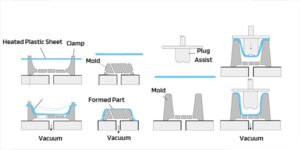
Vacuum Forming
Vacuum forming applies negative pressure to draw the heated sheet onto the mold. It remains the simplest and least expensive option. Typical applications include packaging trays, blister packs, and disposable medical containers. Parts stay relatively shallow and require minimal detail on the non-mold side.
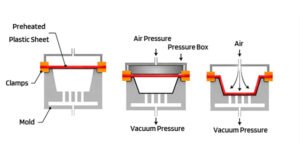
Pressure Forming
Pressure forming introduces positive air pressure above the sheet in addition to a vacuum below. The extra force improves surface replication and allows sharper corners. It is used for automotive interior panels, equipment housings, and point-of-sale displays where appearance matters. Wall thickness distribution improves compared with vacuum forming alone.
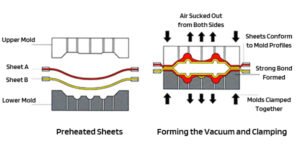
Twin Sheet Forming
Twin sheet forming is a more advanced thermoforming technique that involves heating two plastic sheets simultaneously and forming them against separate molds. The two formed halves are then fused while still hot, creating a single, enclosed structure. This process is particularly valuable for producing hollow parts with enhanced structural integrity, such as ducts, tanks, and double-walled enclosures. It eliminates the need for secondary assembly in many cases. However, twin sheet forming requires precise synchronization and more complex tooling, making it less suitable for simple or cost-sensitive projects.
Materials Used in Thermoforming
Material choice affects performance and cost. Common materials include :
- ABS provides good impact resistance and is widely used for structural components.
- PET is preferred in packaging due to its clarity and recyclability.
- PP offers excellent chemical resistance but can be more challenging to form due to its narrow processing window.
- PVC suits chemical resistance but require ventilation during processing.
- PC delivers high clarity and toughness, yet costs more.
Advantages of Thermoforming
- Low tooling cost is the most significant advantage of the thermoforming process**.** Compared to injection molding, tooling can be reduced by a substantial margin, making it ideal for projects where upfront investment must be minimized.
- Fast lead time is another strong advantage. Thermoforming molds can be produced quickly, allowing a faster transition from design to production. This is particularly valuable in product development cycles where speed matters.
- The process also supports large part sizes with relative ease. Producing large, thin-walled components via injection molding would require extremely large machines and molds, whereas thermoforming handles such geometries more efficiently.
- Design flexibility is also an advantage. Modifications to tooling are generally less complex, enabling iterative design adjustments without high cost.
Disadvantages of Thermoforming
- Thickness variation is one of the most common challenges. As the sheet stretches during forming, material distribution becomes uneven, which can compromise structural integrity.
- Low precision is another constraint. Compared to injection molding, thermoforming cannot achieve the same level of tight tolerances or intricate detail. This makes it less suitable for components requiring high-dimensional accuracy.
- Material waste is also a concern. The trimming process generates scrap, which, although sometimes recyclable, still represents inefficiency in material usage.
- Limited in complex geometries—especially those involving undercuts or internal features—are difficult or impossible to achieve without additional processes.
Thermoforming vs Injection Molding
Both thermoforming and injection molding are processes used in plastic manufacturing. The following table has a quick comparison of those two processes.