Surface scratches are one of the most common quality issues in injection molded parts, but they are also one of the most loosely defined. In practice, the same visible defect may be described as a scratch, drag mark, scuffing line, or even a mold mark depending on the factory or engineer.
The confusion comes from the fact that these marks rarely have a single cause. Some appear during mold release, some are created by friction inside the cavity, and others only show up after the part has already been ejected and handled. From a visual standpoint they may look similar, but the conditions behind them are very different.
In this article, we will break down injection molding surface scratches in a practical way: what they are, how they are typically categorized, what causes them at different stages, and how they can be prevented in real production.
What Is a Injection Molding Surface Scratch?
When you pick up a molded plastic part and notice a faint line, a dull streak, or a slightly rough trace on an otherwise smooth surface, that is typically what engineers refer to as a surface scratch defect. It is not always dramatic or deep—sometimes it is so subtle that you only see it under light reflection or at a certain angle.
In simple terms, a surface scratch is any unwanted linear or scuffed mark caused by friction between the plastic part and another surface. That “other surface” could be the mold cavity, ejector components, or even other parts during production and handling.
So when we talk about “scratch defects,” we are really describing a family of surface damage that shares one simple idea: the part experienced friction at some point in its journey from molten plastic to finished component.
Types of Surface Scratches
A molded part does not move from cavity to finished product in a single step. It goes through a sequence of separation, sliding, and handling. At each stage, contact conditions change, and different types of scratches can appear.
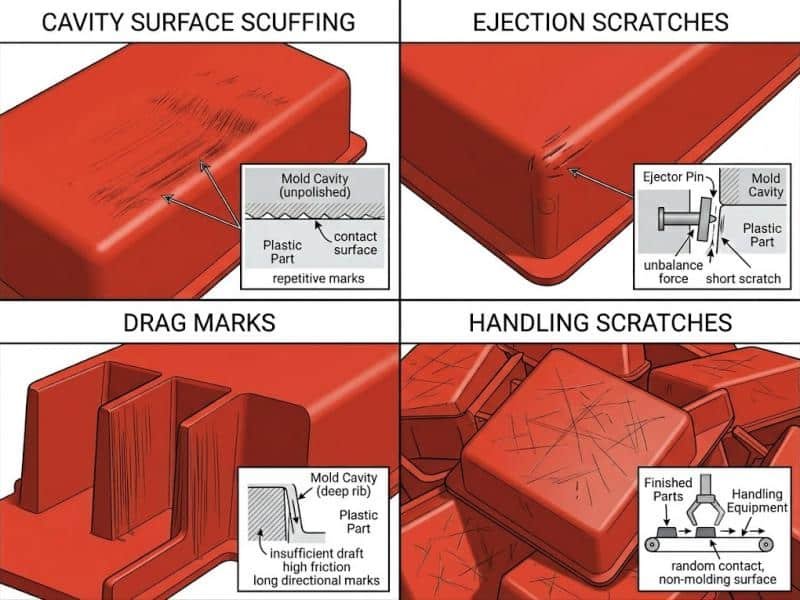
Cavity Surface Scuffing
Some scratches originate while the part is still inside the mold cavity.
These marks are typically associated with the condition of the mold surface itself. If the cavity has insufficient polishing, local wear, machining marks, or contamination, the plastic surface will repeatedly come into contact with these imperfections during cooling and early separation.
Because the contact condition is fixed by the tool, the marks often appear in the same location across multiple cycles.
Ejection Scratches
Ejection scratches occur when the part is pushed out of the mold while still partially constrained by the cavity.
They are typically related to uneven release resistance and imbalanced ejection force. When the part does not move straight during ejection, localized contact with the cavity surface can occur, leading to short scratch marks.
Improving ejector balance and ensuring sufficient draft angle in high-resistance areas helps reduce this type of defect.
Drag Marks
Drag marks are created when the part slides along the cavity wall during demolding.
They are mainly associated with insufficient draft angle, deep ribs, or tight geometries that increase friction during release. The longer the sliding distance under contact pressure, the more visible the directional scratch marks become.
Increasing draft angle and improving part release geometry are the most effective ways to reduce drag marks.
Handling Scratches
After ejection, the part is no longer constrained by the mold, but it can still be damaged during handling and transfer.
Scratches at this stage are caused by external contact, such as robotic grippers, conveyors, storage bins, or part-to-part contact. Since these contacts are not controlled by the mold geometry, the resulting marks are usually random in direction and location.
How to Prevent Surface Scratches in Injection Molding
Prevention is mainly about reducing unnecessary surface contact during the moments when the part is still vulnerable. In practice, this is achieved through a few focused design and process decisions.
- Improve mold surface stability and consistency: Ensure cavity surfaces are properly polished and regularly maintained. Even minor wear or contamination should be addressed early to avoid repeated surface contact marks on molded parts.
- Design for smooth and low-resistance release: Use sufficient draft angles and avoid deep or tight geometries that can trap the part. A smoother release path reduces the chance of surface rubbing during movement.
- Balance and stabilize the ejection process: Keep ejection force evenly distributed across the part. Proper ejector layout helps prevent tilting or localized pressure that can lead to surface dragging during release.
- Control part condition before ejection: Ensure adequate cooling time so the part has enough rigidity before it is released. A part that is too soft is more likely to deform slightly and contact the cavity surface.
- Minimize uncontrolled contact after molding: Use proper gripping design, spacing, and handling methods during robotic or manual transfer. Avoid part-to-part friction in bins or during stacking and transport.
Conclusion
If you have read this far, you can probably already see that most injection molding surface scratches are not random defects, but part of a broader category of issues that can also appear in other quality problems. If you want a more complete overview, you can also look at defects in injection molding products to understand how these issues connect in real production.
If you are developing custom molded components and need support with design or manufacturing decisions, Zhongde provides practical guidance from design review to production through our injection molding service and custom plastic parts manufacturing.