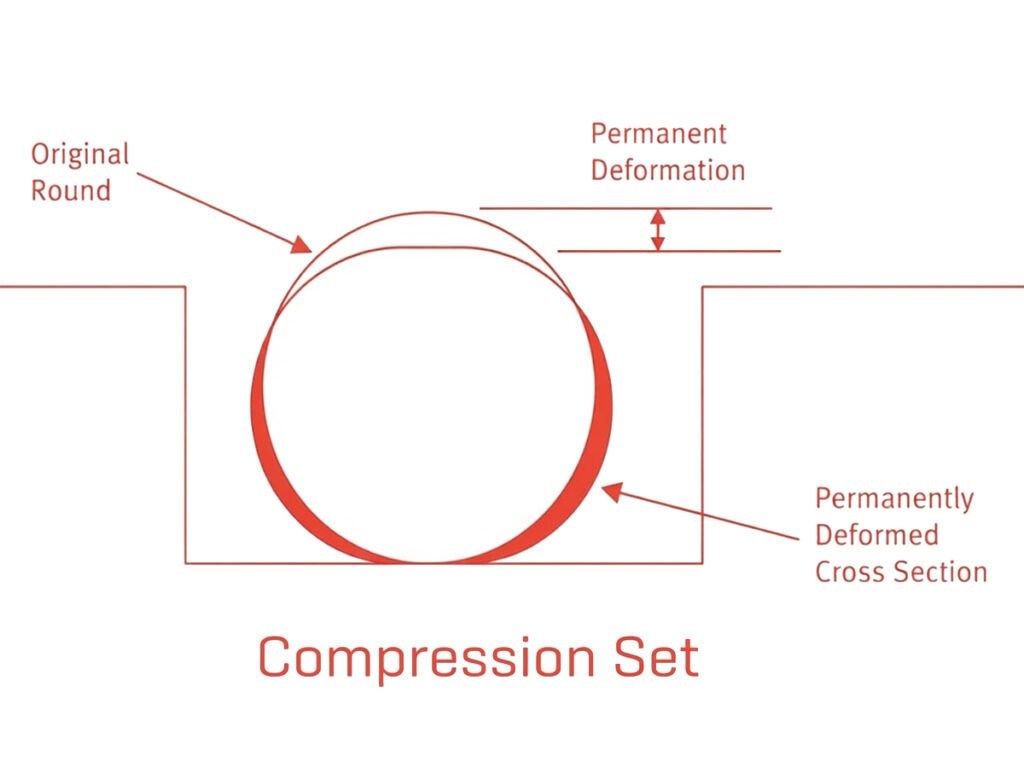
Soft materials such as rubber are well known for their ability to return to their original shape after being compressed. However, we may also notice that when a rubber part is compressed too much or held under pressure for too long, it does not always fully recover. Some deformation may remain even after the load is removed.
How well a material recovers after compression is measured by a key performance indicator called compression set. As an important performance indicator for elastomers, compression set helps engineers evaluate material behavior under long-term compression.
What Is Compression Set?
Imagine pressing a rubber ball and holding it for a while. When you release your hand, the ball may slowly return to its original shape, but it may not become exactly the same as before. Compression set describes how well a rubber material can recover after being compressed for a period of time.
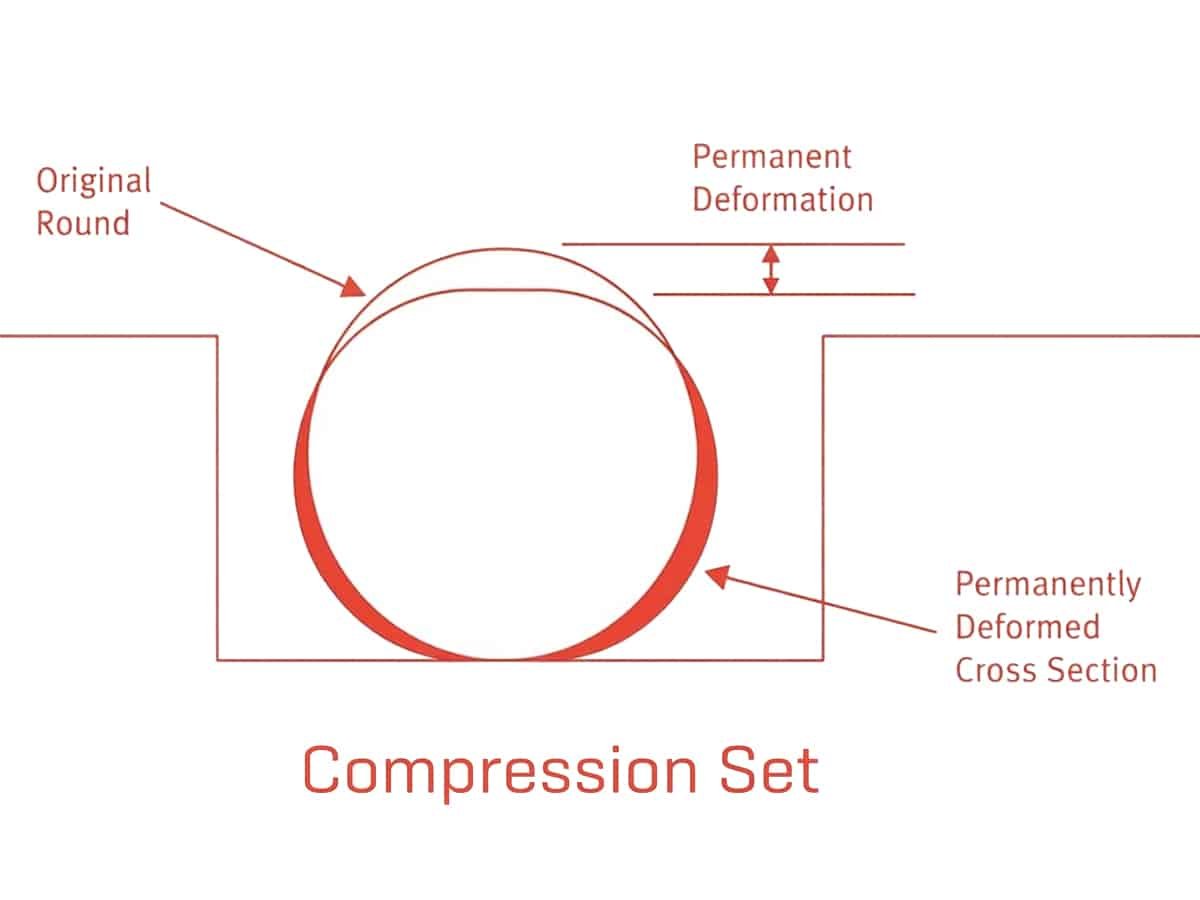
Compression set is a measurement of how much an elastomer fails to return to its original shape after compression. It is usually expressed as a percentage. A lower compression set means the rubber recovers better after being compressed, while a higher compression set means more permanent deformation remains.
Why Does Compression Set Matter?
Compression set is an important factor when designing rubber components that need to perform reliably under continuous compression. A material with unsuitable compression set performance can affect product durability, sealing reliability, and overall service life.
Maintain Long-Term Sealing Performance
Many rubber parts, such as gaskets and O-rings, work by staying compressed between two surfaces. Over time, if the material cannot recover well after compression, the contact pressure between the rubber part and the mating surfaces may decrease. This can lead to seal failure, leakage, or reduced protection against dust and moisture.
Improve Product Service Life
Rubber components are often expected to work for thousands of hours under constant pressure, temperature changes, or harsh environments. A lower compression set helps the material maintain its original function for longer, reducing the risk of premature replacement and maintenance.
Support Material Selection
Different applications require different levels of compression set performance. Engineers can use this property together with hardness, tensile strength, temperature resistance, and chemical resistance to select suitable elastomers and optimize part designs for specific working conditions.
What Factors Influence Compression Set?
Compression set is not determined by the rubber material alone. The final performance of a rubber part depends on several factors, including material type, operating conditions, and manufacturing processes. Understanding these factors helps engineers choose suitable materials and avoid performance issues during use.
Temperature
Temperature has a significant impact on compression set, especially when rubber parts operate in hot environments. Higher temperatures can accelerate molecular changes inside the elastomer, making it more difficult for the material to recover after long-term compression.
For example, a rubber gasket used near an engine may experience much higher compression set than the same gasket tested at room temperature. This is why high-temperature applications often require elastomers designed for better heat resistance.
Compression Level and Duration
The amount of compression and the time under compression also affect compression set. Generally, higher compression levels and longer exposure times create more stress inside the rubber material, increasing the chance of permanent deformation.
For instance, an O-ring compressed beyond its recommended range may lose its ability to recover properly after repeated use. Proper compression design helps balance sealing performance and long-term durability.
Material Formulation and Curing Process
The formulation of an elastomer and the curing process used during manufacturing can influence its final compression set performance. Factors such as crosslink density and curing conditions determine how the rubber responds to long-term compression.
For example, under-cured rubber may not achieve the required strength and recovery properties, while improper curing conditions can lead to inconsistent performance between batches.
Part Design and Application Conditions
The design of a rubber component also affects its compression set performance. Part geometry, compression ratio, and how the component is installed all influence the stress distribution inside the material.
For example, a gasket designed with excessive compression may provide strong initial sealing force but may experience faster loss of recovery over time. A well-designed part applies enough compression to seal effectively without overstressing the material.
How Is Compression Set Tested?
To compare the compression performance of different rubber materials, engineers need a standardized testing method that produces measurable results. Since factors such as compression ratio, temperature, and testing time can affect the outcome, compression set testing is performed under controlled conditions to ensure reliable and repeatable measurements.
The Basic Testing Process
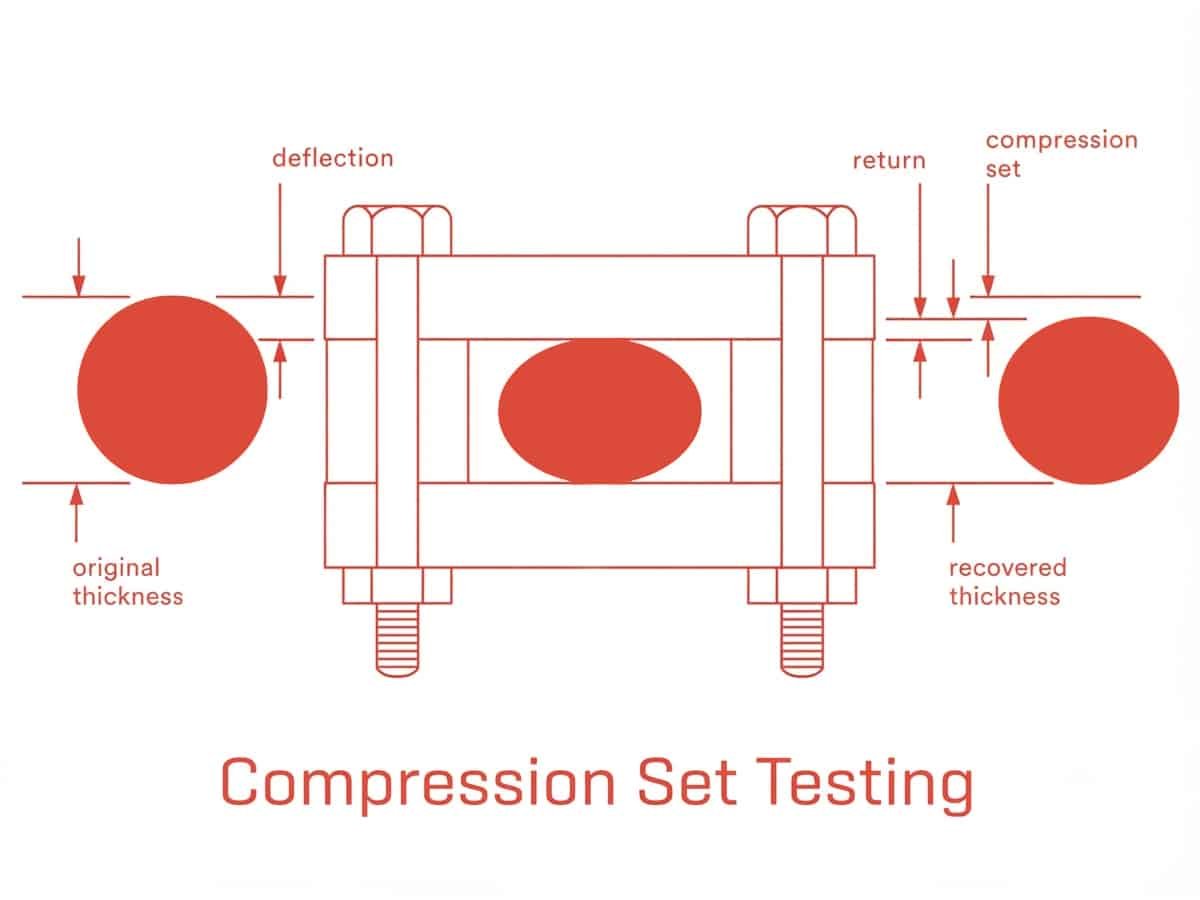
A typical compression set test starts by measuring the original thickness of a rubber specimen. The sample is then compressed to a specific thickness using a testing fixture and maintained under compression for a defined period, usually at a controlled temperature.
After the compression period ends, the load is removed and the specimen is allowed to recover. The final thickness is measured after recovery, and the difference between the original and final thickness is used to calculate the compression set value.
How Is Compression Set Calculated?
Compression set is usually expressed as a percentage (%), representing the amount of permanent deformation compared with the original compression distance.
The calculation is:
Compression Set (%) = (t₀ – t₁) / (t₀ – t₂) × 100
Where:
- t₀ = original thickness of the specimen before compression
- t₁ = final thickness after recovery
- t₂ = thickness of the specimen during compression
For example, if a rubber sample is originally 10 mm thick and compressed to 7.5 mm during testing, the available recovery space is 2.5 mm. If the sample recovers to 9.5 mm after testing, the compression set is 20%, meaning the material permanently lost 20% of its original recovery capacity.
Common Testing Standards
Compression set tests are commonly performed according to standards such as ASTM D395 and ISO 815. These standards specify important test conditions, including specimen dimensions, compression ratio, temperature, and testing duration, ensuring that results can be compared consistently.
For example, a rubber material tested at room temperature for a short period may show a different compression set value compared with the same material tested at elevated temperatures for a longer duration. This is why test conditions are always reported together with compression set results.
How to Define the Right Compression Set Requirement for Rubber Parts
There is no universal compression set value that works for every rubber part. The right requirement depends on how the component functions, where it operates, and what performance it needs to maintain throughout its service life. Engineers usually evaluate compression set together with other application requirements to determine a suitable target.
Start with the Function of the Rubber Part
The required compression set level depends on the role of the rubber component. Sealing parts such as gaskets and O-rings usually require lower compression set because they need to maintain contact pressure and prevent leakage over time.
For components such as vibration mounts or cushioning pads, compression set should be evaluated together with other properties, including flexibility and energy absorption, because
Consider Required Service Duration
The required compression set performance also depends on how long the part needs to maintain its function. A rubber component used for short-term compression may have different requirements from one that remains compressed for years.
Defining the expected service period helps engineers determine whether a standard compression set value is sufficient or whether additional testing is needed.
Match Test Conditions with Real Applications
Compression set values should always be considered together with the conditions under which they are measured. Test temperature, compression level, and duration can significantly affect the results.
A compression set value measured under mild conditions may not accurately represent performance in a demanding application. Testing conditions should be selected to reflect the actual operating environment as closely as possible.
Conclusion
Compression set is a key factor in evaluating rubber material performance, especially for components that experience continuous compression. Understanding how this property is tested and what influences it helps engineers select suitable materials, optimize part designs, and improve long-term product reliability.
At Zhongde, we provide custom rubber parts with support in material selection and manufacturing process optimization. Explore our range of rubber materials to find the right material for your application, or contact us to discuss your project requirements.