Injection speed is one of the most critical parameters in the injection molding process. It determines how quickly molten plastic enters the mold cavity and directly affects part quality, cycle time, and production efficiency. A proper understanding of injection speed is important to optimize the injection molding process and minimize defects.
To fully understand how injection speed interacts with other process settings and how to optimize overall production quality, check out our comprehensive guide on injection molding process parameters and how to optimize them.
What Is Injection Speed?
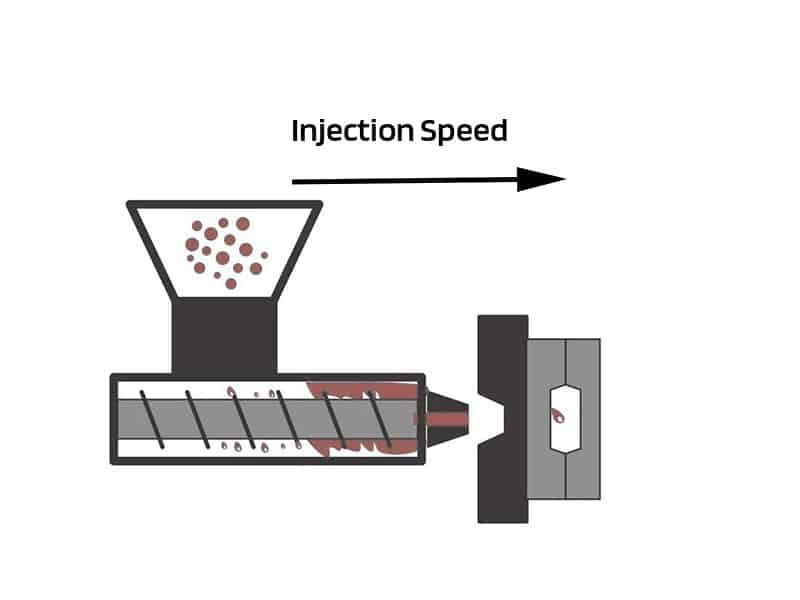
Injection speed refers to how fast the molten plastic is pushed into the mold cavity during the injection phase of the molding process. It is typically controlled by the machine’s screw or injection unit and determines how quickly the material fills the cavity after entering the gate. In simple terms, it is the “flow rate” of the plastic inside the mold, and it directly influences how the material behaves as it travels through different sections of the part.
Why Is Injection Speed Important?
Injection speed controls how molten plastic flows into the mold, much like syrup filling the corners of a detailed mold. If it’s too slow, the material may cool early and leave incomplete areas, like honey starting to harden before it spreads out. If it’s too fast, the flow becomes turbulent, like a rushing stream splashing against rocks, which can cause air traps, burn marks, or surface defects.
When properly balanced, the flow becomes smooth and controlled, like a steady current guiding water evenly through a channel. This helps the cavity fill completely, improves surface finish, and reduces weld lines and internal stress.
How to Calculate Injection Speed?
The basic calculation for injection speed uses a simple relationship:
Injection speed = Shot volume ÷ Injection time
For example, if a mold requires 50 cm³ of molten plastic and the injection time is 2 seconds, the average injection speed is 25 cm³/s. However, this calculation serves only as a starting point. In practice, engineers must account for factors such as material viscosity, wall thickness, mold temperature, and part geometry. Adjustments may also be required during trial runs or simulations to achieve the desired results.
Characteristics of High and Low Injection Speed
Injection speed is not just a number—it shapes how your parts look and perform. Understanding the characteristics of high and low speed helps you make smarter decisions in molding.
High Injection Speed
Think of it like a fast-flowing river rushing into a valley. High speed can:
- Quickly fill the mold: Ideal for thin-walled or intricate parts where rapid flow prevents premature cooling.
- Enhance surface gloss: Fast flow can smooth out minor texture imperfections, giving a polished finish.
- Increase risk of defects: Just as a rushing river can erode its banks, high speed may cause flash, jetting, or burn marks if not controlled.
- Shorten cycle time: Speeds up production but requires careful monitoring to avoid compromising quality.
Low Injection Speed
Imagine gently pouring honey into a mold—slow, steady, and deliberate. Low speed can:
- Reduce internal stress: Slow filling allows the material to settle, minimizing warpage and sink marks.
- Improve dimensional accuracy: The part can form more uniformly, preserving tight tolerances.
- Risk incomplete filling: For thin or complex sections, slow speed may lead to short shots or flow hesitation.
- Better control over delicate features: Ideal for intricate details where precision matters more than speed.
Concept of Multi-Stage Injection Speed
Multi-stage injection speed means the filling process is divided into different speed zones, rather than using one constant speed from start to finish. You can think of it like filling a glass of water: you start carefully to avoid splashing, pour faster in the middle, then slow down again near the top to prevent overflow.
In injection molding, the same idea applies. A lower initial speed helps the melt “enter smoothly” and avoid jetting, a higher middle speed ensures the cavity is filled quickly and evenly, and a controlled final speed helps reduce defects like flash or trapped air. Each stage guides the flow more precisely, like adjusting a river’s current as it moves through narrow and wide channels.
This step-by-step control helps balance quality and stability, especially for complex or thin-walled parts where a single constant speed may not be enough.
Principles for Setting Reasonable Injection Speeds
Setting injection speed follows several guiding rules derived from flow behavior and practical experience.
- The principle of injection speed is to target a consistent melt-front velocity across the cavity. Variable cross-sections mean volumetric flow rate must change to keep front speed steady, reducing flow marks and internal stress.
- Fill runners and manifolds at a higher speed. This shortens overall cycle time and prevents premature cooling in feed systems.
- Reduce speed at or near the gate. Slow entry avoids jetting, gate blush, or splay, particularly with amorphous materials like PC, PMMA, or ABS through side or pinpoint gates.
- Accelerate in the main cavity after the gate. Moderate to high speed improves gloss, strengthens weld lines, and ensures complete filling before wall solidification advances too far.
- Decelerate sharply in the final 10–15% of fill. Low speed controls pressure rise, prevents flash, and protects the mold from excessive force.
- Match the speed profile to part geometry and material. Thin, long paths need higher overall speeds; thick sections benefit from slow-fast-slow patterns to avoid sink or voids. Crystalline resins like PP or PA tolerate faster filling; amorphous types require more caution to preserve clarity.
- Use short-shot progressive fills and cavity pressure curves for refinement. Start with low uniform speed, increase incrementally, assign stages based on appearance, and fine-tune transition positions.
- Coordinate speed with other parameters. Higher speed often requires a corresponding pressure increase to overcome resistance; slower speeds allow lower pressure but demand careful hold time to pack adequately.
Improving Product Defects Through Injection Speed
Injection speed is often one of the fastest ways to correct or reduce common molding defects. By adjusting how quickly the melt enters and fills the cavity, you can directly influence flow behavior, pressure balance, and surface quality.
Short Shots
When the cavity is not fully filled, it often means the melt is losing heat too quickly or facing too much resistance. Increasing injection speed helps the material “reach the corners before it freezes,” like water flowing faster to fill every gap in a narrow channel.
Flow Marks
Flow marks usually appear when the melt front moves unevenly or slows down during filling. A more stable or slightly higher speed helps maintain a consistent flow front, like keeping a steady current instead of a stop-and-go stream.
Jetting
Jetting happens when the melt shoots into the cavity like a thin high-speed jet and then folds irregularly. Reducing or controlling the initial injection speed helps the material “land” gently against the wall first, rather than shooting straight into open space.
Burn Marks (Gas Trapping)
Excessively fast filling can trap air and compress it, causing burn marks. Adjusting the speed—especially slowing down in early or critical filling zones—allows air to escape smoothly, like opening a valve before pressure builds up.
Weld Lines
Weld lines form when two flow fronts meet but do not fuse properly. A well-controlled injection speed helps maintain melt temperature and flow energy so the fronts merge more completely, like two streams joining with enough force to blend into one.
Warpage
Uneven filling can create internal stress differences that later lead to warpage. A balanced injection speed profile helps distribute material more uniformly, reducing internal “pulling forces” as the part cools and solidifies.
Conclusion
Injection speed is not a single fixed value but a dynamic profile tailored to material, mold geometry, and quality targets. Multi-stage control allows precise management of filling behavior, balancing fast cycles with defect-free parts. When set reasonably, injection speed enhances surface finish, dimensional accuracy, internal integrity, and production efficiency. Zhongde provides professional injection molding services with an experienced team. Welcome to contact us and get a high-quality molding service.