Threads are one of the most common mechanical features in engineering, but also one of the most confusing when you start looking at them in detail. Depending on where you search, you may find different names, overlapping categories, and even conflicting explanations for the same type of thread.
This article is designed to bring order to that complexity. Instead of treating thread types as a long, disconnected list, we will break them down into several clear classification systems, so you can quickly understand what each type actually refers to and how they relate to each other.
What Is a Thread?
A thread is a helical ridge wrapped around a cylinder or cone, designed to convert rotational motion into controlled axial movement or to create a mechanical fastening between parts.
In simple terms, it is the spiral feature you see on screws, bolts, nuts, and pipe fittings. When two threaded parts are engaged, their helical profiles interlock, allowing them to either hold components tightly in place or move in a controlled way depending on the application.
In practice, this interaction is influenced by several factors at the same time—load direction, sealing requirements, motion accuracy, material behavior, and manufacturing method. A thread designed for sealing a pipe behaves very differently from one used in a fastener or a transmission system.
This is the reason thread design is not a single unified form, but a system of different types. To understand them clearly, it helps to break threads down from a few distinct engineering perspectives.
What Are the Basic Elements of a Thread?
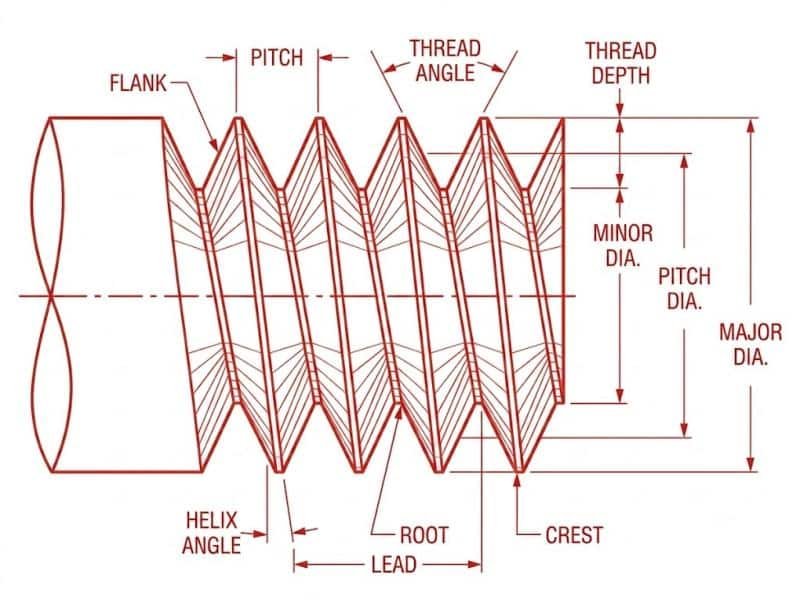
Before looking at different thread types, it is important to understand the basic building blocks that define any thread geometry. Most variations in thread design are actually combinations or adjustments of these core parameters.
Major Diameter
The major diameter is the largest diameter of a thread, measured from crest to crest on an external thread. In practical terms, it is the “outer size” that determines how the threaded part fits into a mating component. For most fasteners, this is the nominal size you see in specifications such as M6 or 1/4”-20.
Minor Diameter
The minor diameter is the smallest diameter of the thread, measured from root to root. It represents the inner core of the thread profile. This value is critical for strength, especially in internal threads, because it directly affects how much material is left to carry load.
Pitch
Pitch is the distance between two adjacent thread crests. It defines how tightly or loosely the thread is spaced. A smaller pitch means finer threads with more engagement per length, while a larger pitch allows faster assembly with fewer turns.
Lead
Lead is the axial distance a thread advances in one full rotation. For single-start threads, lead equals pitch. For multi-start threads, lead is a multiple of pitch, which allows faster linear movement per turn.
Thread Depth
Thread depth is the vertical distance between crest and root. It influences both engagement strength and manufacturing difficulty. Deeper threads generally provide stronger mechanical interlock but require more careful molding or machining control.
Thread Angle
Thread angle refers to the included angle between the flanks of the thread profile. It influences how load is distributed along the thread surfaces and affects both strength and friction behavior.
Flank
The flank is the angled surface connecting the crest and root. It is the primary load-bearing surface of a thread, meaning most of the force during tightening or motion transfer is carried along this area.
Crest and Root
The crest is the top surface of the thread, and the root is the bottom valley between threads. These regions influence stress concentration and fatigue performance, especially in high-load or repetitive assembly conditions.
Types of Threads and How They Are Classified
At first glance, classifying threads in multiple ways may seem unnecessarily complicated. However, each classification system answers a different question about a thread: where it is located, which standard defines it, how its profile is shaped, or how it behaves during operation.
By looking at threads from these different angles, you can avoid confusion caused by overlapping names and better understand why the same thread may appear under different categories in engineering references.
By Position and Basic Geometry
This category describes threads based on where the thread is located and how its basic shape is formed. It is the most intuitive way to understand thread types because it focuses on the physical structure rather than performance or standards.
Male Threads
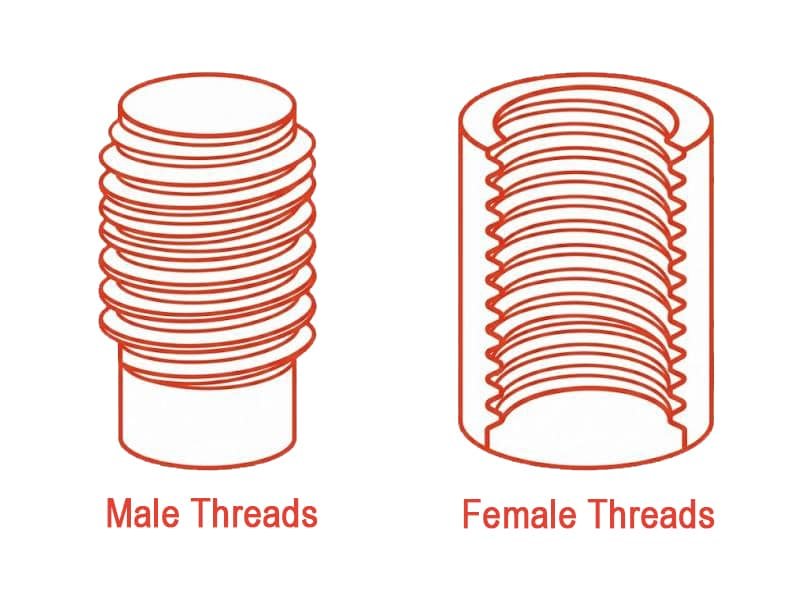
Male threads are located on the outer surface of a cylindrical part. They are designed to engage with internal threads in a mating component, such as a nut or a tapped hole. In practice, this is the most common form used in bolts, screws, and fasteners where the threaded part is externally visible.
Female Threads
Female threads are cut or formed inside a hole. They receive male threads and provide the mating interface for assembly. This type is commonly found in nuts, housings, and molded parts with threaded inserts.
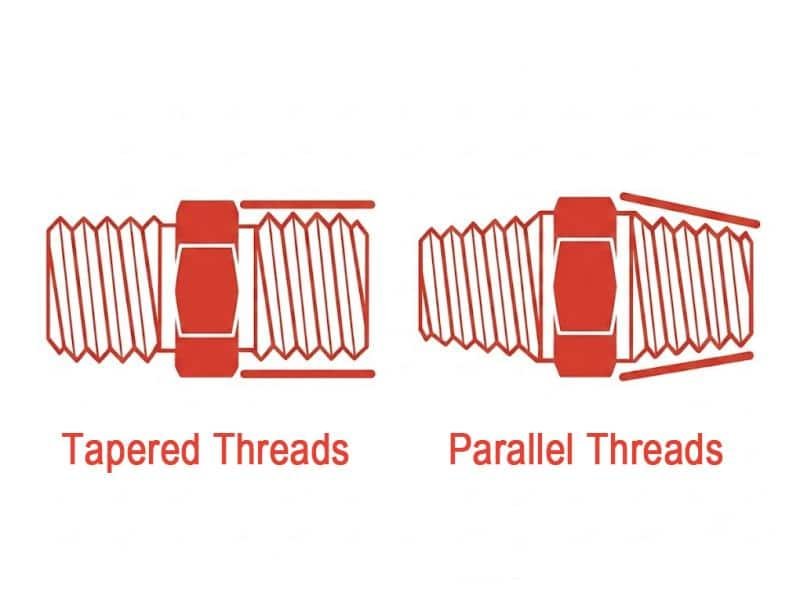
Tapered Threads
Tapered threads gradually decrease or increase in diameter along their length. This geometry allows the threads to wedge tightly as they are tightened, which helps create a pressure-resistant seal. They are commonly used in pipe and fluid systems where leakage prevention is important.
Parallel Threads
Parallel threads maintain a constant diameter along the engagement length. Unlike tapered threads, they do not rely on interference for sealing. Instead, they depend on thread fit and often require additional sealing elements such as washers or sealants.
By Industrial Standard System
This category is based on engineering standards defined by different organizations and industries. Unlike geometry-based classifications, these threads may look similar in shape, but they are not interchangeable because they follow different dimensional rules, tolerances, and application systems.
ISO Metric Threads (M)
ISO Metric Threads are the most widely used standard in modern engineering. They are defined by the ISO system and typically labeled with an “M” followed by a diameter value, such as M6 or M10. These threads are used in general mechanical assemblies worldwide and are the default choice for most metric-based product designs.
Unified Thread Standard (UTS)
UTS threads are commonly used in the United States and Canada. They are defined in inches and typically expressed in formats such as 1/4”-20 or 3/8”-16. Although similar in function to ISO metric threads, they are not directly compatible due to differences in pitch and measurement units.
British Standard Whitworth (BSW)
British Standard Whitworth (BSW) is an older thread system characterized by a 55-degree thread angle. Although less common in new designs, they are still found in legacy equipment and maintenance applications. Their rounded thread profile also differs from modern V-thread standards, which affects compatibility.
National Pipe Thread (NPT)
NPT threads are designed specifically for pipe and fluid systems in North America. They use a tapered geometry to create a mechanical seal as the threads are tightened. In many cases, thread sealant or tape is still required to ensure leak-free performance under pressure.
British Standard Pipe threads (BSP/BSPT)
British Standard Pipe Threads (BSP / BSPT) are commonly used in Europe, Asia, and many Commonwealth countries for piping systems. BSPP (parallel) and BSPT (tapered) variants exist, allowing different sealing strategies depending on the application. They are not directly interchangeable with NPT, even though they may appear similar in size.
By Thread Profile Shape
This category focuses on the cross-sectional shape of the thread. In engineering terms, the profile is not just a visual difference—it directly affects how load is distributed, how motion is transmitted, and how efficiently the thread performs under different working conditions.
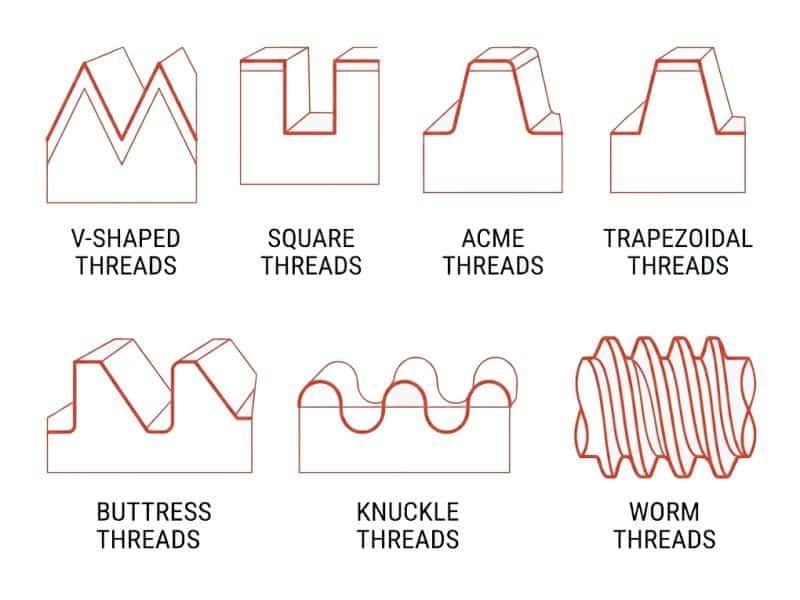
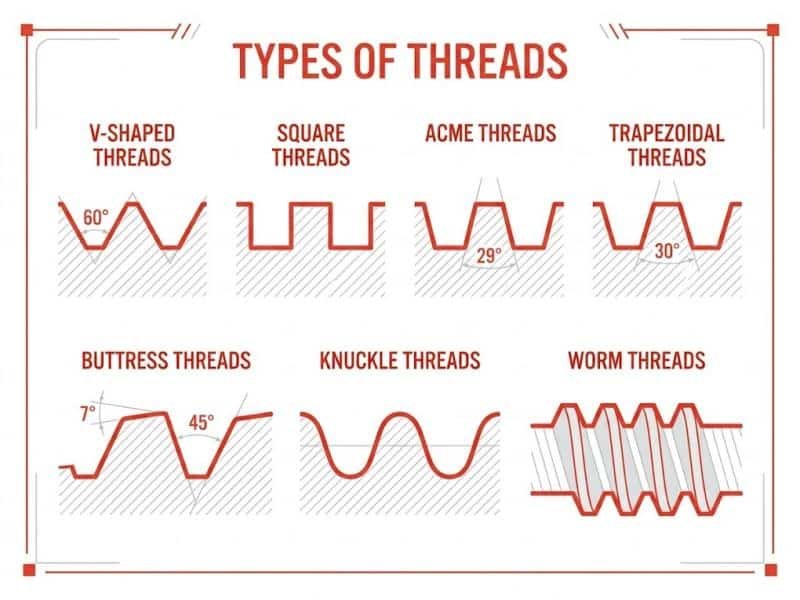
V-Shaped Threads
V-shape threads are the most common profile used in general-purpose screws and bolts. The angled flanks allow the load to be distributed evenly along the thread surfaces, making them suitable for a wide range of fastening applications. Most standard ISO and UTS threads are based on this V-profile geometry.
Square Threads
Square threads have nearly vertical flanks, which minimize radial forces and reduce friction during motion. This makes them highly efficient for transmitting linear motion or power, such as in lead screws. However, they are more difficult to manufacture and less resistant to wear compared to other profiles.
Acme Threads
Acme threads are a modified trapezoidal profile with a slightly angled flank. Compared to square threads, they are easier to manufacture and more robust under load. This makes them a common choice for industrial lead screws and motion systems that require both strength and practicality.
Trapezoidal Threads
Trapezoidal threads are the metric equivalent of Acme threads. They are designed for power transmission applications that require smooth motion and good load-carrying capacity. Their wider root improves strength, making them suitable for long-stroke mechanical systems.
Buttress Threads
Buttress threads are designed with an asymmetric profile. One side carries the load while the other side is nearly vertical. This makes them ideal for applications where force is applied in one direction only, such as jacks or clamping systems under heavy axial load.
Knuckle Threads
Knuckle threads feature a rounded profile that reduces stress concentration and prevents damage from dirt, wear, or misalignment. Their smooth geometry makes them suitable for applications where frequent cleaning or harsh environments would damage sharper thread forms, such as glass containers or couplings.
Worm Threads
Worm threads are used in worm gear systems, where a screw-like shaft turns a gear that is mounted at 90 degrees, allowing large speed reduction in a compact space. Although not used for fastening, they are critical in motion control systems requiring high precision and load reduction.
By Rotation Behavior
This category describes how a thread moves during engagement—specifically the direction it tightens and how far it advances with each rotation. Unlike geometry or standards, this is a functional classification that directly affects assembly speed, locking behavior, and motion efficiency.
Right-Hand Threads
Right-hand threads tighten when rotated clockwise and loosen counterclockwise. This is the most widely used configuration in engineering and manufacturing, largely because it matches natural hand motion and is considered the global default. Unless there is a specific functional requirement, right-hand threads are typically assumed in design.
Left-Hand Threads
Left-hand threads tighten in the opposite direction, meaning they secure when turned counterclockwise. They are used in special cases where vibration or operating direction could cause a standard thread to loosen. Typical examples include rotating equipment or components with directional motion that could unintentionally unwind a right-hand thread.
Single-Start Threads
Single-start threads advance a fixed distance equal to one pitch per full rotation. This provides predictable engagement and is ideal for most fastening applications where controlled tightening is more important than speed. They are the most common configuration in screws and bolts.
Multi-Start Threads
Multi-start threads contain two or more helical paths running in parallel. This increases the lead without changing the pitch, allowing the part to advance much faster per rotation. They are commonly used in applications like quick-actuating closures or motion systems where speed of movement is important.
Conclusion
In real engineering work, you don’t always need to think about threads through every theoretical category we covered. In many cases, selecting a thread is simply a matter of choosing the correct specification, then confirming basic fit, load, and sealing requirements.
If you want to go deeper into manufacturing details, you can also explore how threads are produced in different processes, such as molded threads and CNC threads, where design decisions directly affect cost, accuracy, and production feasibility. If you need support on real projects, Zhongde provides practical engineering guidance and Custom Mold and Tooling Service to help you turn your specifications into production-ready parts.