

Deformation in plastic injection molding refers to changes in the shape or size of molded parts that occur during or after the manufacturing process. It is a common injection molding defect process. Zhongde, 40+year injection molding company, is specializes in custom plastic and rubber molding services.
Types of Deformation in Injection Molding
Plastic deformation during injection molding can manifest in various forms, each impacting the final part in different ways. The most common types of deformation include:
Warping: Warping injection molding involves the bending or twisting of the part, often seen in flat or large-area components. Warping occurs when plastic cools unevenly, creating internal stress that distorts the part, especially when the wall thickness is not uniform.

Sink Marks: Sink marks are depressions or dimples that form on the surface of plastic parts, typically in areas where the material is thick. This happens when the part cools and the thicker sections contract more than the surrounding areas, creating visible surface imperfections.
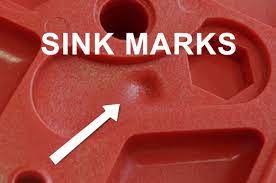
Shrinkage: Shrinkage is the reduction in size that happens as the plastic cools and solidifies. While some shrinkage is inevitable, excessive shrinkage can lead to dimensional inaccuracies, compromising the part’s fit and function.

Diagnosing Deformation Problems
Diagnosing the causes of deformation in plastic parts requires a systematic approach.
The first step is visual inspection. A deformed plastic part will often show visible signs, which can help identify the problem.
Next, precise dimensional measurement can assess the extent of deformation. Comparing the actual dimensions of the part with the design specifications can reveal if shrinkage or warping has occurred.
Lastly, thermal analysis is for detecting temperature-related issues during the molding process. Uneven cooling rates can cause differential shrinkage across the part, leading to warping or shrinkage.
Effects of Deformation on Molded Parts
Deformation in injection molding can have significant repercussions on the mechanical properties and aesthetics of the final products.
Compromised Mechanical Properties
Deformation can result in weakened structural integrity and reduced mechanical strength of the molded parts. Warping, for example, can lead to uneven stress distribution, affecting load-bearing capabilities and causing premature failure in critical applications. Sink marks can create localized weak spots, reducing impact resistance and overall durability.
Aesthetic Defects
Deformation defects, such as warping, sink marks, and shrinkage, can mar the appearance of injection-molded products. Surface irregularities and dimensional inaccuracies may render the parts visually unappealing and unsuitable for applications where aesthetics are crucial, such as consumer products.
Functional Issues
In certain applications, precision is vital for proper functionality. Deformation can lead to misalignments, interferences, or poor fitment with other components, resulting in impaired product performance or assembly difficulties.
Quality Concerns
Deformation-related defects can compromise the overall quality of injection-molded products, reducing customer satisfaction and potentially leading to costly product recalls or rework.
Causes of Plastic Injection Molding Deformation
Several factors can contribute to the deformation of plastic parts during injection molding.
Material Properties
Some plastics with high thermal expansion coefficients, such as ABS or polypropylene, exhibit greater shrinkage during cooling. Fillers like glass fibers can cause anisotropic shrinkage, where contraction varies by direction, leading to warping in deformation plastic part.
Mold Design
Inadequate venting, inconsistent wall thickness, or poor cooling channels can result in uneven cooling and material flow, leading to warping or shrinkage. Improper gate locations lead to uneven material flow, inducing stresses that cause deformation injection molding in large flat areas. Ejection systems with insufficient support can add mechanical stresses, deforming the part during removal.
Process parameters
High injection speeds or pressures create internal stresses that manifest as distortion upon ejection. Inadequate cooling time allows parts to deform under their own weight or residual heat.
Solving Deformation Problems in Injection Molded Parts
- Reduce shot volume, injection speed, and holding pressure to prevent excessive internal stress and keep the melt filling and shrinking more uniformly.
- Adjust mold temperature, cooling time, and waterline layout to ensure consistent cooling across all areas of the part and minimize warpage from uneven shrinkage.
- Lower ejection resistance by improving venting and polishing in the ejection direction so the part isn’t pulled or distorted during demolding.
- Optimize the ejection system based on the part’s geometry; add or enlarge ejector pins in high-resistance areas to balance the ejection force and avoid local deformation.
- Reduce wall-thickness variations as much as possible to avoid shrinkage concentration; for large housings, use fixtures or supports to help maintain shape during cooling.
- Improve cavity surface finish and ensure polishing follows the ejection direction to reduce friction and ejection stress.
- Apply post-treatment or stress-relief processes for high-precision parts to minimize deformation caused by residual internal stress.
- For severe warpage, systematically review flow balance, holding-pressure switch-over, mold-temperature differences, and ejection design, then fine-tune parameters to stabilize the final part shape.
Conclusion
Welcome to contact Zhongde and get an injection molding solution. We can effectively minimize the risk of deformation in the molding process. With their expertise in mold design, material selection, and process optimization, Zhongde can proactively address potential issues, preventing deformation before it occurs and reducing costly defects.


