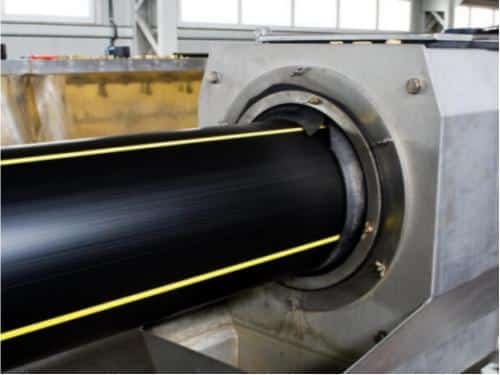
Have you ever noticed how plastic pipes, aluminum rods, or rolled sheets appear everywhere in daily life, yet rarely catch our attention? Unlike injection molding, which produces intricate and precise parts, extrusion mainly creates flat, long, or rolled profiles. At first glance, it may not seem as “high-end” or refined, but this simple yet powerful process quietly supports a vast range of industrial and consumer products. Understanding how extrusion works and why it’s so widely used reveals the hidden backbone of modern manufacturing.
What is Extrusion?
Extrusion is a process that transforms raw material into long, continuous shapes by forcing it through a shaped opening called a die. Imagine squeezing toothpaste out of a tube: the toothpaste flows through the narrow opening and comes out in a uniform shape. Similarly, in extrusion, plastics, metals, or rubber are pushed or drawn through a die, emerging as pipes, rods, sheets, or other profiles with consistent cross-sections.
Unlike injection molding, which fills a cavity to produce a single, discrete part, extrusion is continuous. This allows manufacturers to produce hundreds of meters of material in a single run, with the same profile and dimensions repeated precisely along its length. The simplicity of the process doesn’t make it any less vital; in fact, extrusion quietly underpins many industrial and consumer products we rely on every day.
Types of Extrusion
Before diving into the specific methods, it helps to know that extrusion isn’t just one uniform process—different techniques change how the material flows, how much force is needed, and what shapes you can achieve. Let’s take a closer look at the main types of extrusion and picture how each one works in action.
Direct (Forward) Extrusion
Picture squeezing toothpaste from a tube—the paste moves forward as you push. In direct extrusion, the billet is pushed through the die in the same direction as the ram. This is the most common method for metals and plastics, ideal for producing rods, pipes, and profiles. It’s simple, efficient, and works well for long, continuous shapes.
Indirect (Backward) Extrusion
Imagine pulling dough through a funnel, but this time the funnel moves toward the dough instead of pushing it. In indirect extrusion, the die moves while the billet stays mostly stationary. This reduces friction and heat buildup, producing smoother surfaces and requiring less force—perfect for delicate or intricate shapes.
Hot Extrusion
Think of stretching warm taffy—it becomes soft and pliable, easy to shape into intricate forms. Hot extrusion heats the material (commonly metals like aluminum or copper) before pushing it through the die. Heating makes the material easier to work with and allows for more complex designs, though it may slightly compromise surface finish and precision.
Cold Extrusion
Visualize pressing firm clay at room temperature—harder to shape, but the finished piece is stronger and more precise. Cold extrusion is performed without heating, requiring more force, but it produces parts with superior surface finish, dimensional accuracy, and strength. It’s often used for precise components like bolts, tubes, and automotive parts where tight tolerances matter.
Extrusion Process
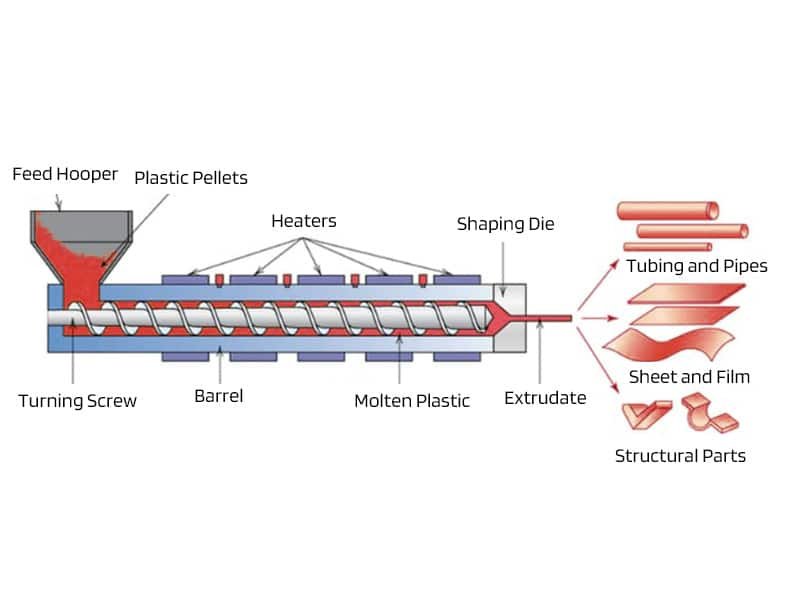
Now that we’ve explored the different types of extrusion, let’s see how the material actually moves from raw form to finished shape. From feeding raw material to shaping it into continuous profiles, understanding each stage helps you see why the process works and how it can be optimized for different materials and designs.
Step 1: Material Preparation
Before extrusion starts, the raw material is prepared. For plastics, this means pellets or granules; for rubber, it’s a compound mix. The material may be dried or blended with additives to ensure consistent flow and performance. Imagine gathering and measuring ingredients before cooking—a small mistake here can affect the entire batch.
Step 2: Feeding and Melting
The prepared material is fed into a heated barrel. A screw or ram pushes it forward while applying heat, causing thermoplastics or metals to soften, and rubber to become pliable.
Step 3: Shaping through the Die
The molten or softened material is then forced through a die, which determines the profile of the extruded product—pipes, sheets, tubes, or more complex shapes. This is like squeezing frosting through a piping tip: the nozzle’s shape directly defines the final form.
Step 4: Cooling or Curing
Once the material exits the die, it needs to solidify while keeping its shape. Plastic profiles are usually cooled with water baths or air, rubber may be vulcanized, and metal may be quenched or allowed to cool gradually.
Step 5: Cutting and Finishing
Finally, the continuous extruded profile is cut to length or rolled into coils. Additional finishing steps like trimming, coating, or printing may be applied. It’s like slicing a long loaf of bread or a ribbon of fondant: precise cuts ensure uniform pieces ready for use or assembly.
Materials Used in Extrusion
Extrusion works with a wide range of materials, depending on the desired properties of the final product. Commonly used options include:
- Plastics: PVC, PE, PP, ABS, Nylon
- Metals: Aluminum, Copper, Steel
- Rubber and Elastomers: EPDM, Silicone
- Composites: Fiber-reinforced plastics and hybrid materials
These materials are chosen based on their flow properties, strength, and how well they hold shape after extrusion, making it easy to match the right material to the job.
Advantages and Limitations of Extrusion
Advantages
- Consistent Shapes: Extrusion excels at producing long parts with a uniform profile. This consistency is perfect for pipes, rods, and structural profiles.
- Efficient Production: Once the die is set, extrusion can run continuously, making it ideal for high-volume production. It’s like a conveyor belt for material shapes, keeping output steady and predictable.
- Material Versatility: Extrusion works with a wide range of materials, from metals to plastics and rubbers. This flexibility allows manufacturers to choose the best material for strength, flexibility, or chemical resistance without changing the process.
- Cost-Effectiveness for Long Parts: Compared to other shaping methods, extrusion reduces waste and tooling costs for continuous profiles. The longer the part, the more you benefit—just like baking multiple loaves of bread in a single oven.
- Easy Post-Processing: Extruded parts can be easily cut, drilled, or coated afterward, making it simple to move from extrusion to finished products without complicated steps.
Limitations
- Shape Restrictions: Extrusion works best for uniform cross-sections. Complex 3D shapes are like trying to squeeze a star-shaped cookie through a round cookie cutter—it just won’t come out right.
- Die Cost: Creating a custom die can be expensive. Think of it like commissioning a tailor-made mold—it’s worth it for long runs, but not for a single piece.
- Material Limitations: Not all materials behave well under extrusion. Some metals and plastics may crack or warp if forced through a die incorrectly.
- Size Limitations: The maximum length and diameter are limited by the press and die setup, so very large or very tiny parts may require alternative methods.
Applications of Extrusion
Extruded shapes might seem simple at first glance, but they play essential roles in many everyday items. Let’s explore the practical applications that bring them to life.
Construction and Architecture
Extrusions become the frameworks and veins of modern buildings—window frames, weatherstripping, and insulation channels channel structure and protection. They resist the elements, guiding the flow of air, water, and light while maintaining strength and flexibility.
Automotive Components
Extruded materials act as the skeleton and skin of vehicles, forming trim, seals, and weatherstrips that guard against noise, moisture, and vibration. From flexible rubber gaskets to sturdy plastic profiles, extrusion shapes the hidden frameworks that keep cars quiet and resilient.
Industrial Equipment
In factories, extrusions are the pipelines and conduits of machinery. Conveyor guides, protective covers, and structural rails transmit motion, force, and stability, ensuring machines operate smoothly and safely.
Electrical and Electronics
Here, extrusions form the veins and shields that carry and protect currents. Cable channels, heat sinks, and housing parts conduct energy and safeguard sensitive components, keeping devices reliable and long-lasting.
Consumer Goods
Everyday items—from kitchen tools to sporting goods—rely on extrusion to deliver consistent shape and performance. Plastic tubes, handles, and protective coatings form the backbone of products we use daily, silently enhancing comfort and durability.
Conclusion
Extrusion might seem like a technical process, but as you’ve seen, it’s a versatile tool that shapes the materials around us—literally. By understanding the types, materials, advantages, and limitations, you’re now better equipped to make informed decisions for your projects.
At Zhongde, we combine decades of manufacturing expertise with flexible extrusion solutions to help you bring ideas to life. From prototyping to mass production, our team is ready to support your project every step of the way.