Causes, Prevention, and Solutions for Ejector Pin Marks
Table of Content
Ejector pin marks are common defects in injection molding processes and significantly impact the quality and appearance of molded parts. Ejector pin marks typically appear on the surface of molded parts at the points where the ejector pins make contact during the ejection process. In this post, we will explore the causes of ejector pin marks and learn how to prevent them in injection molding.
What Are Ejector Pin Marks?
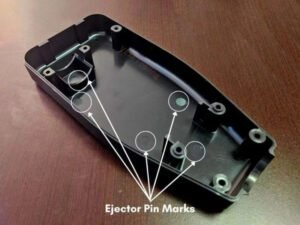
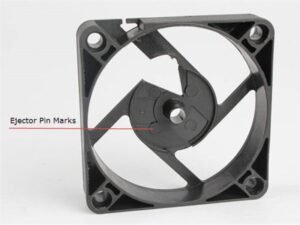
Ejector pin marks are visible defects or blemishes that appear on the surface of injection-molded plastic parts. Since ejector pins must contact the part during ejection, minor marks are normal; only pronounced indentations, whitening, or surface irregularities that affect appearance or function are considered true defects and worth attention and optimization. Ejector pin marks typically look like glossy or white imprints, indentations, depressions, or varying levels of glossiness (dark or shadow-like areas) on the part’s surface, directly opposite the location where the ejector pins contacted the part during ejection from the mold cavity.
Ejector Pin Marks
What Do Ejector Pin Marks Look Like?
Ejector pin marks on a plastic product are visible indentations, depressions, or blemishes on the surface of an injection molded plastic part. They can manifest in different ways:
Shallow Indentation Marks: These appear as small indentations or dimples in the shape of the ejector pin, typically on the surface that contacts the ejector pin during ejection from the mold. Positional deviations of the ejector pin cause them.
Whitening or Glossy Marks: In these cases, the color at the ejector pin area becomes lighter or glossier, forming white spots or halos. These can appear on both the surface contacting the pin and the opposite side. They are caused by stress exerted during ejection or temperature differences.
Discolored Marks: The area around the ejector pin may appear slightly discolored compared to the surrounding areas, often appearing shinier.
How Ejector Pin Marks Affect Molded Parts?
Ejector pin marks can impact injection-molded parts in several ways:
Aesthetic Impact
Functional Issues
Marks in critical areas can interfere with assembly, operation, or fit with mating components.
Structural Concerns
Localized stress from pin marks can weaken the part, increasing susceptibility to cracks or reduced durability.
Quality Inconsistency
Uneven occurrence across a batch can lead to variations in appearance and performance, especially problematic for high-tolerance or cosmetic-sensitive applications.
Potential Damage Sites
Pin marks may act as initiation points for future cracks, posing long-term reliability risks.
What Causes Ejector Pin Marks In Injection Molding?
Ejector Pin Marks
Product Design Issues:
Insufficient wall thickness: Excessively thin wall thickness, especially for complex geometries with ribs/bosses (generally <2.5mm for simple parts, <2.8mm for complex parts).
Lack of adequate draft angles or uniform wall thickness: Insufficient draft angles or non-uniform wall thickness can cause parts to stick to the mold, requiring a higher ejection force and potentially causing ejector pin marks.
Presence of ribs, bosses, or complex geometries: Features such as ribs, bosses, or complex geometries may require higher ejection force to release the part from the mold, increasing the likelihood of ejector pin marks.
Mold Design Flaws:
Improper ejector pin size, type, location, orientation, or number of pins: If the pins are too large or improperly positioned, they may exert excessive force on the part during ejection, resulting in indentations or surface scuffing. See more on injection molding ejector pins design.
Inadequate venting: Poor venting can lead to vacuum formation in the cavity, making it difficult for the part to release from the mold and increasing the risk of ejector pin marks.
Uneven cooling: Improper cooling channel design can result in uneven cooling of the mold, leading to differential shrinkage and potential deformation of the part upon ejection, causing ejector pin marks.
Inappropriate gate design: Gate size, location, or type that is not properly matched to the part and mold design can result in improper filling and packing, leading to ejector pin marks.
Processing Conditions:
Excessive injection pressure, speed, or holding pressure: High injection pressures or speeds can lead to overpacking of the cavity, resulting in increased ejection force requirements and potential ejector pin marks.
Rapid cooling: Rapid cooling can cause internal stress build-up in the part, making it more difficult to eject and increasing the likelihood of ejector pin marks.
Too high mold temperature: If the mold temperature is too high, it can lead to material sticking to the mold surface, making it more challenging to eject the part cleanly.
Too low mold temperature: If the mold temperature is too low, it can result in uneven cooling and differential shrinkage, potentially causing distortion or deformation of the part upon ejection.
High ejection force or speed required: If parts stick to the mold due to inadequate release agents or surface finishes, higher ejection forces or speeds may be required, increasing the risk of ejector pin marks.
Material Issues:
Using materials without adequate lubrication or flow additives: Insufficient lubrication or flow additives in the material can increase friction between the part and the mold surface, making ejection more difficult and increasing the likelihood of ejector pin marks.
Mismatch between ejector pin and mold steel conductivity: Mismatched conductivity between the ejector pin and mold steel can lead to uneven cooling and differential shrinkage, potentially causing ejector pin marks.
How to Remove Ejector Pin Marks?
Ejector pin marks on injection-molded plastic parts can be corrected even after the part is finished.
For raised marks, a flat file or sanding stick can be used to carefully remove the protruding area until it is flush with the surrounding surface.
For recessed ejector pin marks, one option is to fill the indentation with putty, such as Tamiya Basic Type putty, let it dry, and then sand it smooth. Another approach is to cut a disc from a styrene sheet, glue it into the recessed mark, and sand it flush with the part surface. Thick gel super glue can also be used to fill the depression; once fully cured, the area can be sanded and polished smooth.
In some cases, applying heat and pressure using a heated tool can help remove marks, depending on the material. For clear parts, filling the recessed area with clear glue, allowing it to level and harden, and then buffing it with a rotary tool can restore a smooth, visually consistent surface.
How to Prevent Ejector Pin Marks in Injection Molding?
Here are some effective ways to prevent ejector pin marks in injection molded parts.
Proper Ejector Pin Design:
Pin Size: Ensuring the appropriate size of ejector pins helps distribute the ejection force evenly across the part surface, reducing the risk of localized pressure points that can cause marks.
Pin Shape: Opting for rounded or tapered pin tips can minimize the risk of sharp indentations or scratches on the part surface during ejection.
Pin Placement: Avoid placing ejector pins on thin walls, curved surfaces, or near gates. Distributing ejector pins evenly and avoiding clustering them in one area can reduce the concentration of force and mitigate the risk of marks.
Optimize Mold Design
Increase draft angles to facilitate easier part ejection and reduce vacuum formation.
Incorporate proper venting to prevent vacuum entrapment.
Design uniform cooling channels for even cooling and reduce internal stresses.
Adjust Processing Parameter
Reduce injection pressure, speed, and dwell time to minimize internal stresses.
Limit the amount of melt injected into the mold cavity.
Optimize mold and barrel temperatures for uniform cooling.
Increase cooling time to allow for gradual, even cooling of the part.
Control ejection speed to reduce impact forces during ejection.
Improve Part Design
Increase wall thickness, especially in areas with ejector pins.
Incorporate reinforcing ribs or bosses in high ejection force areas.
Material and Surface Treatment
Use materials with adequate lubrication and flow additives.
Apply mold release agents properly and evenly.
Increase cavity surface smoothness by polishing along the ejection direction.
Use specialized mold coatings like heat/quick-cure coatings for better release.
Conclusion
Ejector pin marks are caused by multiple factors, including product design, mold design, processing, and materials. At Zhongde, we provide comprehensive custom mold & design solutions that optimize ejector pin design, mold temperature control, and injection parameters. With our expertise in mold tooling and injection molding, we help customers achieve consistent quality, enhanced durability, and visually flawless plastic parts.