
As product design evolves toward multi-material integration, traditional manufacturing often requires producing separate components and assembling them afterward, which increases labor, alignment risks, and overall production cost. Multi-shot injection molding provides a more efficient alternative by combining multiple materials into a single, fully integrated part within one molding cycle.
What Is Multi-Shot Injection Molding?
Multi-shot injection molding is a multi component injection molding process in which two or more materials are injected into a single mold during one machine cycle. Each material is introduced in sequence (or sometimes simultaneously), bonding directly within the mold to form a single finished part. Unlike traditional molding or overmolding, this process is fully automated and completed in one cycle, eliminating the need for secondary assembly, bonding, or alignment steps.
Types of Multi-Shot Injection Molding Technologies
Different tooling and machine configurations are used depending on part complexity and production requirements.
- Two-Shot Injection Molding: The most common method using two materials, widely applied in consumer products, automotive parts, and electronics.
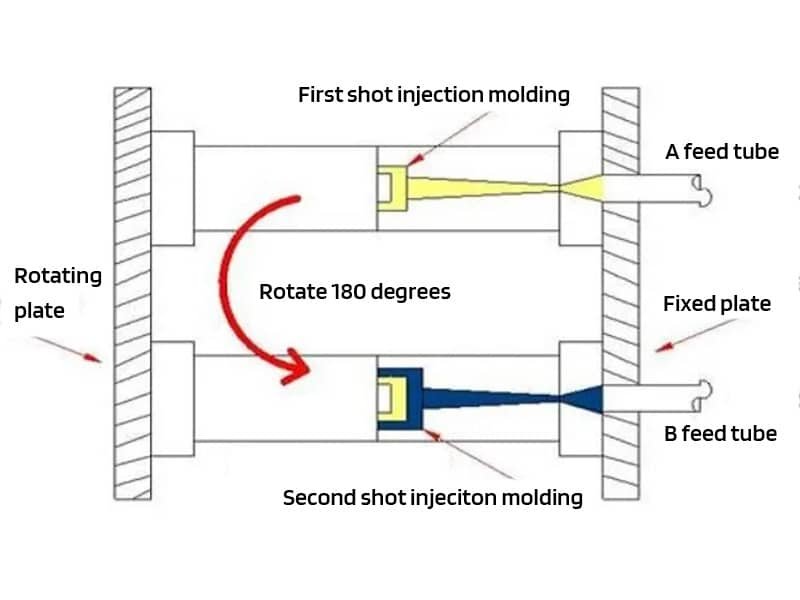
- Rotary Platen Molding: Uses a rotating platen to transfer the part between stations, offering high efficiency and repeatability for high-volume production.
- Transfer Molding Systems: Employs a robotic arm or mechanical system to move the part between cavities, providing greater flexibility for complex geometries.
- Core-Back or Index Plate Systems: Allows dynamic mold changes during the cycle to support intricate multi-material designs.
How the Multi-Shot Injection Molding Process Works
The process follows a controlled sequence within a single machine cycle:
- First shot: A rigid base material is injected to form the structural component
- Transfer or rotation: The part is repositioned within the mold
- Second shot (and additional shots): Secondary materials are injected onto or around the first shot
- Cooling and ejection: The final integrated part is formed and removed
What Products Are Suitable for Multi-Shot Injection Molding?
Multi-shot injection molding is not limited to specific industries. It is best suited for products that require material integration, functional layering, or assembly reduction.
Soft-Touch and Rigid Combination Products
Products that combine rigid structures with soft surfaces are ideal candidates. Typical examples include tool handles, consumer electronics, and personal care products. The rigid material provides structural strength, while the soft layer improves grip, comfort, and usability—all achieved in one molding cycle.
Multi-Color or High-Aesthetic Components
For products where appearance is critical, multi-shot molding allows multiple colors and finishes without painting or secondary processing. This ensures consistent visual quality while reducing production steps and potential defects.
Sealed and Functional Integrated Parts
Multi-shot molding is often used to integrate seals, gaskets, or functional layers directly into a part. This eliminates the need for separate sealing components and improves reliability, especially in applications requiring water or dust resistance.
Precision Components with Multiple Functional Layers
Products that require tight tolerances and precise alignment between materials benefit from the single-cycle nature of multi-shot molding. This is common in connectors, control panels, and electronic components, where accuracy directly affects performance.
Key Advantages of Multi-Shot Injection Molding
Multi-shot injection molding’s main advantages appear in production efficiency, part quality, design options, and overall cost structure for suitable applications and volumes.
1. Simplify Product Structure and Eliminate Secondary Assembly
Multi-shot injection molding combines multiple materials and parts into one piece in a single cycle. This eliminates secondary assembly steps like welding, gluing, or screwing. That means easier supply chain, lower inventory, and fewer assembly defects. Ideal for products like tool handles and toothbrushes.
2. Better Cost Efficiency at Scale
Initial tooling cost is higher, but per-unit cost drops significantly in medium to high-volume production. It saves labor, handling, and secondary processing expenses. Great for products with stable demand, helping improve profit margins or offer competitive pricing.
3. Higher Quality and Consistency
All materials bond inside the same mold, creating stronger and more uniform interfaces. This reduces defects and improves durability. The automated process ensures consistent quality across batches — important for consumer electronics, medical devices, and automotive parts.
4. Greater Design Freedom
It allows easy combination of rigid and soft materials, multiple colors, and functional features like soft-touch grips or integrated seals. This enables better ergonomics, aesthetics, and user experience without adding manufacturing complexity.
Limitations and When to Avoid Multi-Shot Molding
Despite its advantages, multi component injection molding is not suitable for every project.
1. High Upfront Tooling Cost
Multi-shot molds are significantly more complex than standard injection molds, often requiring multiple injection units and precise alignment systems. This leads to substantially higher upfront tooling costs. Not suitable for low-volume production or prototypes.
2. Longer Development Time
Designing and validating a multi-shot process demands careful evaluation of material compatibility, mold design, temperature control, and bonding performance. As a result, tooling development and setup times are typically longer than with standard injection molding.
3. Material Compatibility Constraints
Not all material combinations can achieve reliable bonding during the molding process. Incompatible materials may result in weak interfaces, delamination, or performance issues over time.
Multi-Shot Injection Molding Material Selection
Material selection is central to successful multi-shot molding.
Common substrate materials (first shot) include:
- ABS
- Polycarbonate (PC)
- Polypropylene (PP)
- Nylon
Overmold materials (second or subsequent shots) frequently consist:
- Thermoplastic elastomers (TPE)
- Thermoplastic polyurethane (TPU)
- Liquid silicone rubber (LSR)
Compatibility between materials determines bond strength. Chemically compatible pairs, such as ABS with certain TPE grades or PC with TPU, form reliable molecular bonds during injection. Incompatible combinations may rely on mechanical features in the mold design, such as undercuts or textured interfaces, to achieve sufficient adhesion. Shrinkage rates and melt temperatures must align closely to prevent warping or stress at the material boundary.
As a custom manufacturer, we conduct material compatibility testing and provide recommendations based on the end-use environment, regulatory requirements, and cost targets.
Design Considerations for Multi-Shot Parts
Designing for multi-shot molding requires a DFM (Design for Manufacturability) approach from the early stages. Important design factors include:
Bonding Interface Design: The interface between materials should maximize surface contact or include mechanical locking features.
Gate and Flow Path Optimization: Proper gate placement ensures balanced filling and avoids weld lines or air traps.
Wall Thickness Control: Uniform wall thickness helps prevent warpage and ensures consistent cooling.
Tolerance Management: Multi-material parts may behave differently during cooling, requiring careful tolerance planning.
Avoiding Material Separation: Design features should minimize stress concentration at material interfaces.
Multi-Shot Injection Molding vs Overmolding: Which Should You Choose?
| Key Factor | Multi-Shot Injection Molding | Overmolding |
|---|---|---|
| Process | Single-cycle, fully automated | Multi-step process |
| Tooling Cost | High | Lower |
| Per-Part Cost | Lower at high volume | Higher |
| Precision | High (no repositioning) | Depends on handling |
| Production Volume | Medium to high | Low to medium |
| Material Bonding Quality | Strong and consistent (thermal bonding in one cycle) | Depends on secondary process, more variability |
| Lead Time (Development) | Longer (complex mold design and validation) | Shorter (simpler tooling and setup) |
If your product combines rigid and soft components, or requires multiple colors/textures, multi-shot injection molding is likely a good fit.”
For low-volume prototypes, simple single-material designs, or unconventional material combinations, alternative methods such as overmolding or standard injection molding may be more cost-effective.
Applications of Multi Shot Injection Molding
Multi shot injection molding applications span a wide range of industries due to its versatility.
- Interior buttons and control panels
- Sealing components
- Functional aesthetic parts
- Device housings
- Connectors and cable components
- Surgical instrument handles
- Sealed housings for diagnostic devices
- Soft-touch functional components
- Toothbrushes
- Power tool handles
Conclusion
Multi-shot injection molding is a powerful solution for producing high-performance, multi-material plastic components with improved efficiency and reduced assembly requirements. If your project involves multi-material integration, enhanced product functionality, or design optimization, submit your drawings or specifications, and we will evaluate the feasibility of multi-shot molding and provide a detailed quotation.


