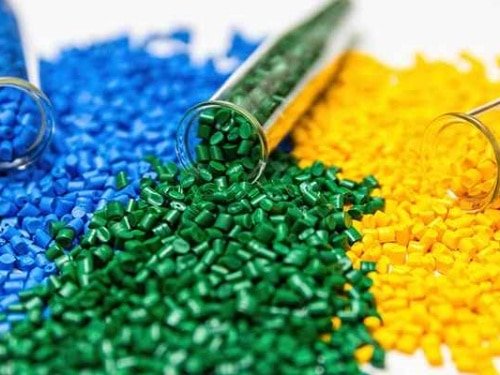
When selecting engineering plastics for injection molded parts, POM and nylon are often two of the most commonly considered options. At first glance, they may seem similar—both are strong, wear-resistant thermoplastics used in mechanical components. However, their material behavior is quite different in real-world use.
In this article, we will break down what POM and nylon are, compare their key properties, and help you determine which material is more suitable for your specific application.
What is POM?
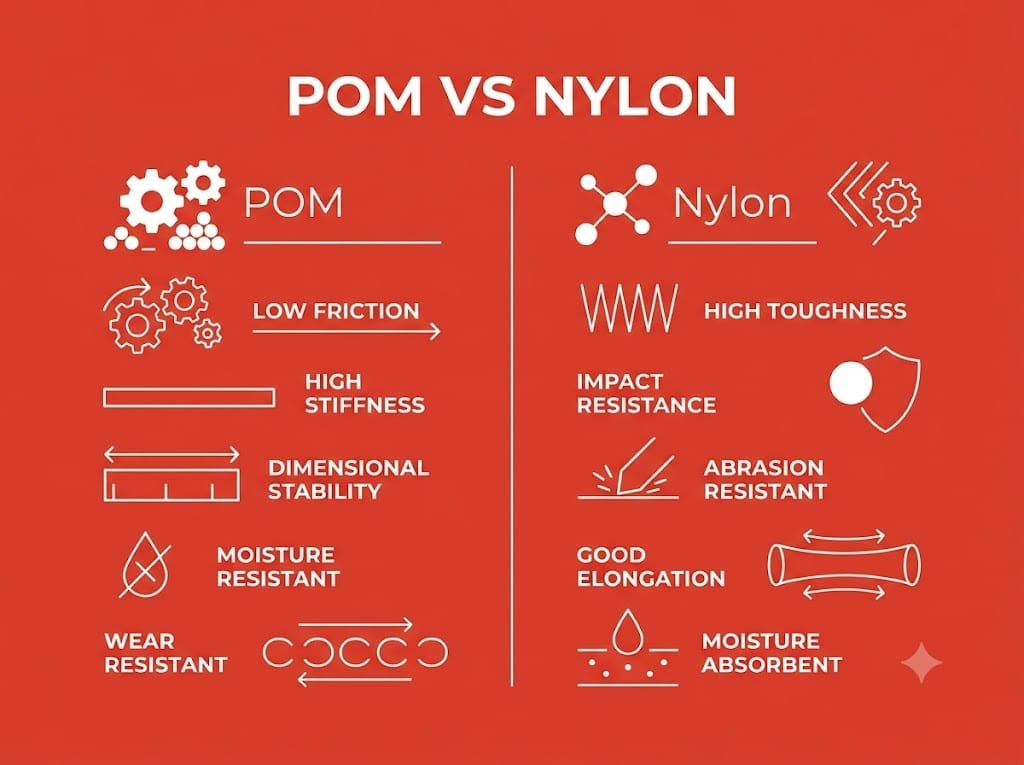
POM, also known as polyoxymethylene or acetal, is a high-performance engineering thermoplastic commonly used in precision mechanical applications. It is a semi-crystalline material with a tightly packed molecular structure, which gives it high stiffness, low friction, and excellent dimensional stability.
POM is also valued for its stable molding characteristics. It fills molds efficiently and can produce parts with fine details and good surface finish, making it suitable for mass production of functional components such as housings, connectors, and small mechanical elements.
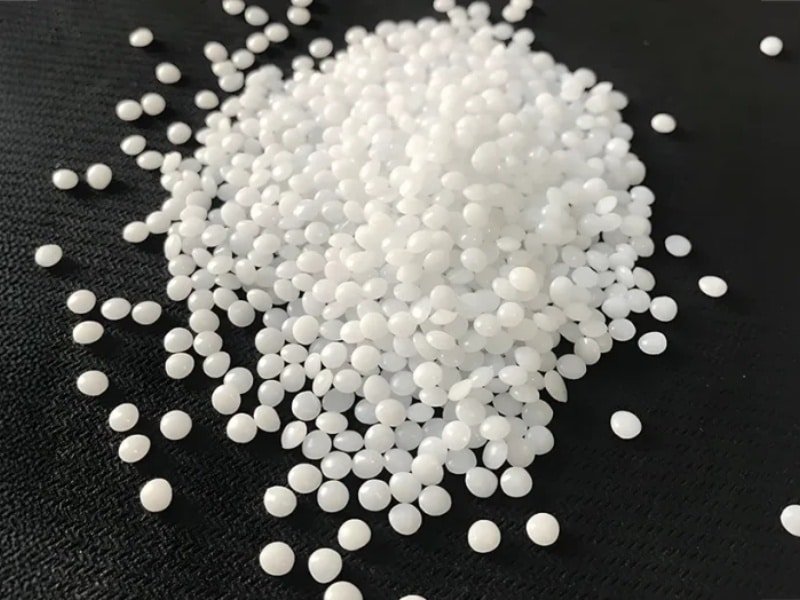
What is Nylon?
Nylon, also known as polyamide (PA), is a family of semi-crystalline engineering thermoplastics widely used in injection molding for durable and functional components. It was originally developed as a synthetic replacement for natural fibers, but today it is commonly applied in molded parts that require reliable mechanical performance.
One of the key characteristics of nylon is its strong molecular chain structure, which allows it to be processed into parts with good toughness and wear resistance. It is available in several common grades, such as PA6 and PA66, each offering slightly different processing behavior and thermal performance.

POM vs Nylon: Material Comparison
To understand which material is more suitable for your application, it is important to look at how POM and nylon behave under different conditions.
Mechanical Properties
The differences in mechanical behavior between POM and nylon mainly come from their molecular structure. POM has a highly regular and tightly packed crystalline structure, which limits internal movement of its polymer chains and results in a more rigid and dimensionally stable material. Nylon, on the other hand, has a molecular structure that allows more flexibility between chains, and it can also interact with moisture, which further influences its mechanical response in real-world conditions.
These structural differences directly lead to distinct performance characteristics in injection molded parts:
- Rigidity: POM is generally stiffer, while nylon is more flexible and deformable under load.
- Impact Behavior: Nylon absorbs impact better, whereas POM is more prone to brittle failure under sudden shock.
- Fatigue Resistance: POM performs well in low-friction, repetitive motion, while nylon handles cyclic loading and vibration more effectively.
- Dimensional Stability under Stress: POM maintains shape more consistently, while nylon may show slight deformation depending on load conditions.
- Wear in Moving Parts: POM is often preferred for precision sliding or rotating components, while nylon is used where toughness is more important than precision.
Chemical Properties
The chemical behavior of POM and nylon is influenced by how their molecular chains interact with different substances. POM has a relatively stable and tightly bonded structure, which gives it good resistance to many common fuels, oils, and solvents. However, it can be sensitive to strong acids and oxidizing agents, which may lead to material degradation over time.
Nylon, in comparison, has a more chemically active structure due to the presence of amide groups in its molecular chain. This allows it to perform well in a range of industrial environments, but it also makes it more vulnerable to certain conditions such as acidic exposure and long-term hydrolysis, especially under elevated temperatures.
Key differences in chemical performance can be summarized as follows:
- Resistance to Oils and Fuels: POM generally performs better in hydrocarbon-rich environments.
- Resistance to Acids: Both materials have limitations, but nylon is more prone to chemical degradation in acidic conditions.
- Solvent Behavior: POM is more stable against many non-polar solvents, while nylon’s performance depends more on grade and exposure time.
- Long-Term Chemical Stability: POM tends to maintain more consistent properties in dry chemical environments, whereas nylon may gradually change due to molecular interaction with moisture and chemicals.
Processing Compatibility
In injection molding, POM is generally easier to process due to its stable melt behavior and low moisture sensitivity. It does not require extensive pre-drying in most cases, and it tends to produce parts with good dimensional consistency and smooth surface finish. Nylon, however, is more sensitive to moisture absorption, so proper drying before molding is essential to avoid defects such as bubbles or inconsistent mechanical performance.
In CNC machining, both materials are commonly used, but they behave differently during cutting and finishing. POM tends to produce clean chips and maintains good dimensional accuracy during machining. Nylon is more flexible and can deform slightly under cutting forces, which may require more careful tool control to maintain precision.