When selecting polyurethane for industrial parts, hardness is often one of the first properties engineers need to consider. It affects how the material performs under pressure, how well it resists wear, and whether it can provide the flexibility or support required in the final application.
Like other material hardness properties, polyurethane hardness determines how soft or rigid the material feels and how it responds under load. Choosing the right hardness level is essential for achieving the right balance between durability, elasticity, and functional performance.
In this guide, we will explain how polyurethane hardness scale is measured, how Shore hardness scales apply to polyurethane, and how to choose the right hardness for different applications.
Why Polyurethane Hardness Matters
PU hardness directly affects how a part performs in real-world conditions. A softer PU material can absorb shocks, provide cushioning, and reduce vibrations, making it ideal for gaskets, seals, and padding applications. On the other hand, a harder PU can withstand heavy loads, resist wear, and maintain its shape over time, which is essential for rollers, wheels, and structural components.
Choosing the right urethane hardness ensures that the material meets your functional requirements without over-engineering the part or causing premature failure. For example, using a very soft PU for a load-bearing roller could lead to deformation and short service life, while using an overly hard PU for a sealing gasket might result in leaks and poor performance.
In short, understanding polyurethane hardness scale helps you balance flexibility, durability, and performance in your design, saving time and cost in prototyping and production.
Polyurethane Hardness in Shore Scale
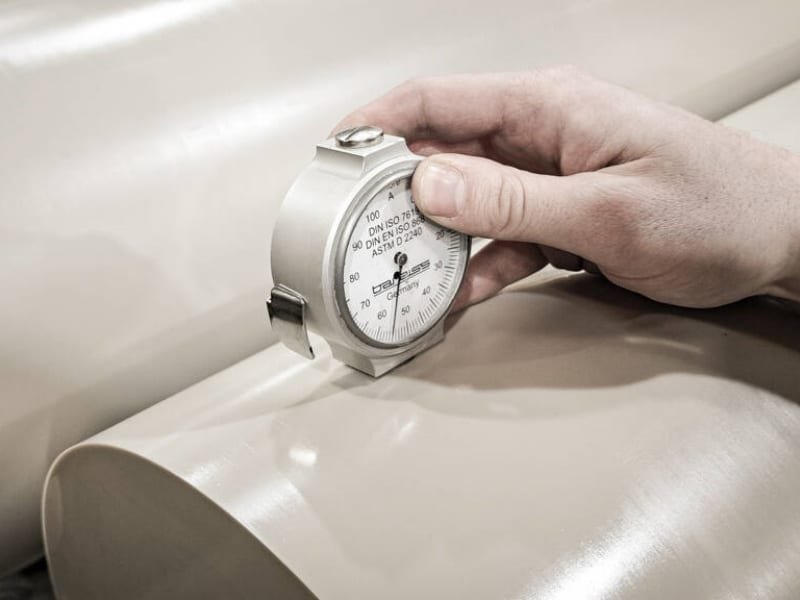
The shore hardness of polyurethane is usually measured using the durometer, also known as a polyurethane durometer or urethane durometer , which indicates how soft or hard the material is based on its resistance to indentation. For polyurethane, the two most common scales are Shore A and Shore D.
- Shore A is used for softer and more flexible polyurethane materials, typically ranging from 10A to 95A. Lower values such as 40A to 60A are suitable for soft seals and cushioning parts, while harder grades around 85A to 95A are often used for wheels, rollers, and wear pads where greater durability is needed.
- Shore D is used for harder polyurethane grades, usually ranging from 20D to 75D. These materials offer higher rigidity and better load-bearing performance, making them suitable for structural parts or applications where deformation must be minimized.
Because polyurethane can be formulated across such a wide hardness range—from soft elastomeric materials to rigid engineering grades—it can be adapted to meet very different performance requirements.
How to Measure Polyurethane Hardness
The measurement of urethane hardness scale is carried out using a durometer instrument. During testing, the durometer tip is pressed against the surface of the polyurethane sample, and the hardness value is read after a short contact time, typically within 1 to 3 seconds. Softer polyurethane materials are measured on the Shore A scale, while harder grades are tested using the Shore D scale.
To ensure accurate results, the sample surface should be flat, clean, and tested at a standard room temperature of around 23°C. It is also common to take several readings at different points on the sample and calculate the average value, especially for molded parts where hardness may vary slightly across the surface. Consistent testing conditions are important for obtaining reliable polyurethane hardness scale measurements.
How to Choose Different Polyurethane Hardness
Polyurethane hardness is usually selected based on how the part will feel and perform in real use. In most applications, the common working range is 30–95A (Shore A), with harder grades extending to Shore D 30–60 for more rigid parts.
Soft polyurethane (30–50A) feels like a rubber eraser or a soft foam pad. It is commonly used in shoe soles, seals, and vibration dampers, where cushioning and comfort are more important than strength.
The most widely used range is 50–75A, which has a firm rubber feel similar to luggage wheels or office chair casters. It is often chosen for industrial rollers, conveyor wheels, and handling parts because it balances durability and flexibility.
Hard polyurethane (75A and above / Shore D) behaves more like hard plastic. It is used in heavy-duty wheels, scraper blades, and machine parts that must keep their shape under load. In most cases, designers start from the 50–75A range and adjust softer or harder depending on whether cushioning or wear resistance is more important.
Conclusion
Polyurethane hardness plays a key role in how a part performs, from soft cushioning to rigid load-bearing applications. Choosing the right hardness is less about a single “best value” and more about matching material behavior to real working conditions.
In most cases, the right selection comes down to balancing flexibility, durability, and wear resistance based on the application environment.
If you are working on a custom project, Zhongde can help you select the right pu material shore hardness and support your project from prototyping to production.