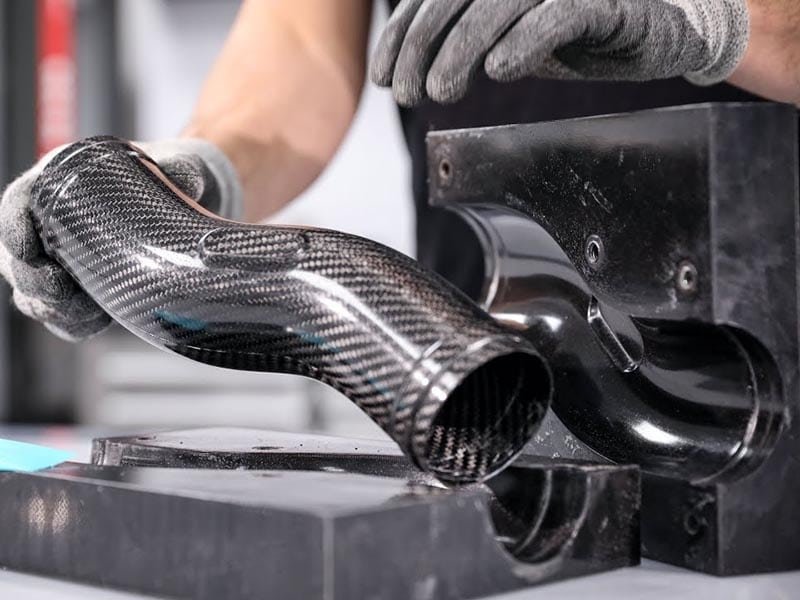
Fiberglass compression molding is one of the most reliable processes for producing high-strength, lightweight composite parts. The method places pre-weighed glass-fiber-reinforced thermoset charge into a heated metal mold, closes the tool under high pressure, and allows the resin to cure before part ejection. The process is widely used in automotive, electrical, construction, and sanitary sectors when compression molded products quantities range from several hundred to several hundred thousand pieces per year.
Learn more about glass filled nylon injection molding.
Types of Fiberglass Materials and Their Characteristics
Fiberglass materials used in compression molding typically fall into several categories, each with its own formulation and performance profile.
SMC (Sheet Molding Compound): SMC consists of chopped glass fibers, fillers, and resin distributed in roll or sheet form. It delivers excellent flow, stable mechanical properties, good surface finish, and reliable dimensional control. These features make SMC suitable for automotive body panels, structural housings, and equipment covers.
BMC (Bulk Molding Compound): BMC contains shorter glass fibers mixed with resin, fillers, and additives in dough-like form. It provides superior electrical insulation, flame retardance, and dimensional stability. It is useful for electrical components, appliance parts, and compact industrial housings.
GMT ( long-fiber thermoplastic composite): It offers higher impact strength and stiffness thanks to its longer glass fiber strands. This material is often selected for load-bearing automotive components, brackets, and reinforcement structures.
How to Choose the Right Fiberglass Material?
Choosing the right fiberglass system for compression molding can be approached in three linked steps: application, environment, and cost/process.
Application Requirements
Structural vs. non‑structural
- Structural parts (e.g., brackets, beams, cross‑members, housings that carry load) demand higher strength, stiffness, and fatigue resistance. These often use high‑fiber‑content SMC.
- Non‑structural or protective parts (e.g., covers, enclosures, cosmetic panels) focus more on dimensional stability, appearance, and impact resistance and can often use lower‑ to medium‑fiber‑content SMC or BMC.
Functional Requirements
Decide which of the following is most critical:
- High stiffness / low deflection
- High impact toughness and fatigue life
- Electrical insulation and tracking resistance
- Flame retardancy and smoke/toxicity performance
- Surface finish and paintability
Application Environment
Temperature
Define the continuous working temperature. High‑temperature electrical or under‑the‑hood parts may need higher‑grade matrices and stable glass/resin combinations.
Chemicals and moisture
For parts in contact with water, salt spray, fuels, oils, or acids/alkalis, choose corrosion‑resistant resin systems and, where necessary, corrosion‑resistant glass or surface protection layers. For outdoor use, consider UV‑resistant gelcoats or coatings.
Cost and Manufacturability
Cost and Volume
For medium‑ to high‑volume production, SMC often offers the best cost‑to‑performance ratio. High‑performance glass or very high fiber contents should be justified by clear structural or environmental demands.
Flow and Moldability
Very high fiber content or very long fibers may give excellent properties but poor flow in thin ribs, deep pockets, or sharp corners. Material selection should be done in parallel with part and mold design, often validated by flow simulation or prototyping.
Advantages and Disadvantages of Fiberglass Compression Molding
Advantages of Fiberglass Compression Molding
High mechanical performance and dimensional accuracy
The combination of fiberglass reinforcement and thermoset matrices supplies high specific strength and stiffness, good creep resistance, and stable dimensions under load and temperature. Closed molds and controlled curing deliver tight tolerances and high repeatability.
Suitable for Medium‑ to High‑Volume Production
Cycle times are usually on the order of tens of seconds to a few minutes, much faster than open‑mold lay‑up. With multi‑cavity tools and automation, throughput can be high enough for automotive and appliance markets.
Integrated design and good surface quality
Ribs, bosses, local thickness variations, and inserts can be molded in one shot, reducing secondary operations. With proper material and mold design, surface finish can be good enough for direct painting or even visible automotive‑class surfaces.
Disadvantages of Fiberglass Compression Molding
High upfront investment and low flexibility
Compression molding requires robust metal tooling and a press with sufficient tonnage, so the initial investment is significant. Design changes are costly, which is a poor fit for low volumes or frequent design iterations.
Geometry and wall thickness limitations
Very thin walls, extremely deep ribs, or intricate undercuts can be difficult to fill and vent, especially with high‑fiber SMC.
Process sensitivity
Part quality is strongly influenced by mold temperature, material pre‑conditioning, charge placement, press speed, and curing time.
Practical Considerations for Fiberglass Compression Molding
When implementing fiberglass compression molding, pay particular attention to:
Material preparation
For SMC, control sheet thickness, fiber content, and maturation time are required to achieve consistent viscosity and flow. For BMC, ensure homogeneous mixing and moisture control to avoid dry spots or segregation.
Charge design and placement
The shape, weight, and location of charge “pucks” or billets significantly affect flow and fiber orientation. A good practice is to place multiple charges to minimize long‑distance flow and reduce knit lines.
Mold design and thermal management
Adequate venting, generous radii, proper draft angles, and uniform temperature distribution reduce defects such as air traps, fiber wash, and differential shrinkage. Cooling and heating circuits should be designed for a consistent cavity temperature.
Process control and quality assurance
Monitor mold temperature, pressure curves, and cure time; use standardized start‑up and shut‑down procedures; and validate mechanical properties on representative parts.
Fiberglass Compression Molding vs. Fiberglass Injection Molding
When selecting a process, it is helpful to compare compression molding with fiberglass injection molding, as both are widely used for reinforced composite parts.