CNC machining has become an essential manufacturing solution for producing accurate and complex parts efficiently, and CNC milling is one of the most widely used processes within it. In this guide, we will break down what CNC milling is, how it works, its main operations, machine types, design considerations, and typical applications.
What Is CNC Milling?
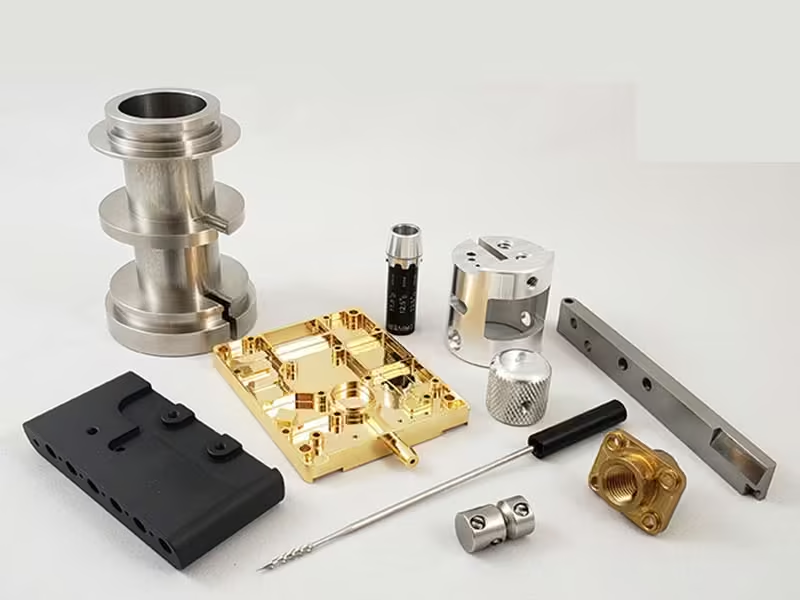
CNC milling is a machining process that uses Computer Numerical Control (CNC) machines to remove material from a solid workpiece using a rotating cutting tool.
The cutting tool moves along multiple axes while the workpiece remains fixed or is repositioned during machining. This controlled movement allows the machine to produce precise shapes from materials such as metals, plastics, and composites.
In simple terms, CNC milling is a process that turns a digital design into a physical part through automated cutting and shaping.
How CNC Milling Works
CNC milling is a step-by-step process that transforms a digital design into a physical part. Although the process is fully controlled by software, each stage still follows a very mechanical and visual workflow.
Designing the CAD Model
Everything starts on a computer screen. Engineers build a 2D or 3D model of the part using CAD software, defining its shape, dimensions, and functional details.
At this stage, the part exists only as a digital object—but every later machining step will follow this exact geometry.
Converting Design into Machining Instructions
Once the design is complete, CAM software translates it into machine-readable instructions (G-code).
You can think of this as converting a “3D model” into a precise movement plan—telling the machine exactly where to move, how fast to cut, and how deep each pass should go.
Machine Setup
Before machining starts, the operator prepares the CNC machine. The cutting tool is installed into the spindle, and the raw material is firmly fixed onto the machine table.
At this point, everything is positioned and locked in place—because even a small shift during machining can affect final accuracy.
Machining Process
Once the program starts, the machine comes to life.
The spindle begins spinning the cutting tool at high speed, while the tool moves across the workpiece along programmed paths. Layer by layer, material is removed in a controlled way, gradually revealing the final shape hidden inside the raw block.
It is a continuous process of cutting, repositioning, and refining until the design is fully formed.
Finishing and Inspection
After machining is completed, the part is removed from the machine. Some parts may go through secondary finishing processes, such as deburring to remove sharp edges or surface treatment to improve appearance and durability.
Finally, the part is inspected to ensure its dimensions match the original design requirements before it is approved for use.
CNC Milling Features and Advantages
CNC milling is widely used in modern manufacturing not just because it is automated, but because it consistently produces reliable and usable parts in real production environments.
High Precision and Stable Accuracy
CNC milling can produce parts with very tight tolerances, often within micrometer levels depending on the machine and material.
In practical terms, this means parts can fit together as intended without manual adjustment during assembly, which is especially important in mechanical systems where alignment affects performance.
Repeatable Production Quality
Once a CNC program is created, it can be reused to manufacture the same part repeatedly with minimal variation.
This makes CNC milling suitable for both prototype validation and mass production, where consistency across batches is critical for product reliability.
Ability to Produce Complex Shapes
CNC milling allows the cutting tool to move across multiple axes, enabling the production of geometries that would be difficult to achieve manually.
Features such as pockets, curves, angled surfaces, and internal structures can all be machined in a single setup, reducing the need for multiple processes.
Material Flexibility
CNC milling can process a wide range of materials, including aluminum, steel, stainless steel, plastics, and engineering-grade polymers.
This flexibility allows engineers to select materials based on function rather than manufacturing limitations.
Efficient and scalable production
Because CNC machines operate automatically once programmed, production can continue with minimal human intervention.
This improves overall efficiency, especially in scenarios where multiple parts are required with consistent quality over time.
Reduced Human Dependency and Errors
Compared with manual machining, CNC milling relies on programmed instructions rather than operator judgment during cutting.
This significantly reduces variability caused by human factors and improves overall process reliability.
Design Factors for CNC Milling Parts
A well-designed part is easier to machine, more cost-effective to produce, and less likely to encounter quality issues during manufacturing. When designing parts for CNC milling, several key factors can directly affect machining efficiency and final part performance.
Wall Thickness
Thin walls may seem practical in design, but they can become unstable during machining. Excessive cutting force may cause vibration or deformation, which affects dimensional accuracy.
Keeping wall thickness consistent helps improve machining stability and reduces the risk of part distortion, especially for plastic or lightweight metal parts.
Internal Corners
CNC milling tools are round, which means perfectly sharp internal corners are difficult to machine.
If a design requires square internal corners, additional operations may be needed, increasing machining time and cost. Designing with appropriate corner radii allows the cutting tool to move smoothly and improves machining efficiency.
Tolerance Requirements
Tight tolerances improve precision, but they also require slower machining speeds and stricter process control.
For this reason, tolerances should only be tightened where function truly demands it. Reasonable tolerance design helps balance machining accuracy and production cost.
Tool Access
Every feature on a part must be reachable by the cutting tool. Deep pockets, narrow cavities, or obstructed areas can make machining difficult.
Designing features with sufficient tool clearance improves manufacturability and reduces the need for specialized tooling.
Material Selection
Different materials behave differently during CNC milling. Softer materials may machine faster, while harder materials increase tool wear and machining time.
Selecting the right material not only affects part performance but also has a direct impact on machining efficiency and overall cost.
Common CNC Milling Operations
CNC milling includes several basic machining operations that are used to create different features on a workpiece. Each operation controls how the cutting tool interacts with the material, and is selected based on the shape or function required.
Face Milling
Face milling is used to create flat surfaces by removing material from the top of a workpiece.
In this operation, the cutting tool moves across the surface like a controlled “planing” process, gradually leveling the material until a smooth and even surface is formed. It is often used as a starting step to prepare a reference surface for further machining.
End Milling
End milling is one of the most versatile CNC milling operations, used to create slots, pockets, and complex 3D profiles.
The cutting tool works not only from the tip but also from the sides, allowing it to “carve into” the material in multiple directions. This makes it suitable for shaping detailed features inside a workpiece.
Slot Milling
Slot milling is used to machine narrow channels or grooves into a part.
The tool moves along a fixed path while cutting into the material, creating precise linear or curved slots. This operation is commonly used when parts need to fit together, guide movement, or hold other components in place.
Angular Milling
Angular milling is used to create surfaces that are set at a specific angle rather than flat.
The cutting tool is positioned to remove material at an incline, producing features such as chamfers or angled edges. These features are often used to improve assembly fit or reduce sharp edges.
Common Types of CNC Milling Machines
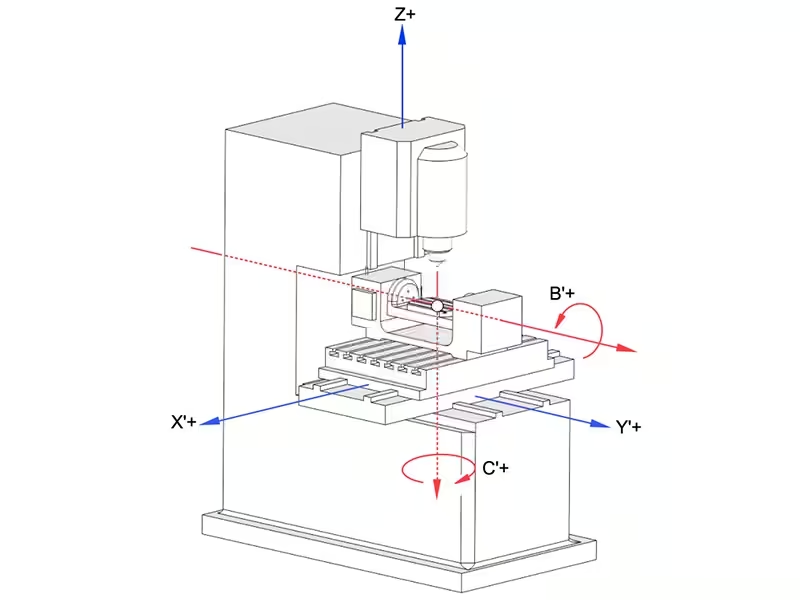
CNC milling machines are often classified by the number of axes they can move along. The more axes a machine has, the more complex the parts it can produce and the fewer setups are required during machining.
3-Axis CNC Milling Machines
A 3-axis CNC milling machine moves the cutting tool along the X, Y, and Z axes.
This is the most common type of CNC milling machine and is suitable for parts with relatively simple geometries, such as flat surfaces, slots, and pockets. It is widely used for standard machining tasks where the part can be accessed from one main direction.
4-Axis CNC Milling Machines
A 4-axis CNC milling machine adds one rotational axis to the standard 3-axis movement.
This additional rotation allows the workpiece to be machined from multiple sides without manual repositioning. It improves efficiency when producing parts with features on several faces.
5-Axis CNC Milling Machines
A 5-axis CNC milling machine adds two rotational axes, allowing the cutting tool to approach the workpiece from multiple angles in one setup.
This makes it possible to machine highly complex geometries with greater precision and fewer setups. 5-axis machines are often used for complex parts where accuracy and surface quality are critical.
Machine Structure Considerations
Besides axis configuration, CNC milling machines may also use vertical or horizontal spindle structures depending on the machining requirements.
Vertical machines are commonly used for general-purpose milling, while horizontal machines are often preferred for larger parts and higher material removal rates.
CNC Milling vs CNC Turning
CNC milling and CNC turning are both precision machining processes, but they remove material in different ways and are suited to different part geometries. Understanding the difference helps determine which process is more suitable for a specific part design.
If you would like to better understand the differences between the two processes, you can refer to CNC milling vs turning for a detailed comparison.
How the Machining Process Differs
In CNC milling, the cutting tool rotates while the workpiece remains fixed. The tool moves along programmed paths to remove material and create features such as slots, pockets, and flat surfaces.
In CNC turning, the workpiece rotates while the cutting tool remains relatively stationary. Material is removed from the outside diameter, making the process ideal for cylindrical parts.
Types of Parts Each Process Is Best Suited for
CNC milling is commonly used for parts with flat surfaces, complex contours, holes, and multi-sided features.
For example, housings, brackets, and mounting plates are often milled because they require multiple surfaces and detailed geometries.
CNC turning is better suited for round or cylindrical parts such as shafts, bushings, pins, and threaded components.
Because the material rotates during turning, round features can be machined quickly and efficiently.
Choosing Between Milling and Turning
If a part has complex surfaces or non-cylindrical features, CNC milling is usually the better option.
If the part is rotationally symmetric, CNC turning is often faster and more cost-effective.
In some cases, both processes are used together—for example, a shaft may be turned first to create the main cylindrical form and then milled to add slots or flats.
CNC Milling Applications
CNC milling is used across many industries because it can produce accurate parts with stable quality and flexible material options. Whether the goal is to machine a complex metal housing or produce a functional plastic prototype, CNC milling is often chosen when precision and repeatability matter.
Producing Precision Structural Parts
CNC milling is commonly used for structural parts such as brackets, housings, mounting plates, and support frames, where dimensional accuracy directly affects assembly quality.
For example, if a mounting hole position shifts even slightly, the part may no longer align with the mating component. CNC milling helps maintain the precision needed for these critical features.
Machining Complex Geometries
Many functional parts include pockets, slots, contours, and stepped surfaces that are difficult to create with simpler machining methods.
CNC milling makes it possible to machine these features accurately in one setup, reducing the need for secondary operations and improving part consistency.
Manufacturing Custom Metal and Plastic Components
CNC milling is widely used to produce custom parts in aluminum, steel, stainless steel, and engineering plastics.
For example, metal components may require strength and wear resistance, while plastic parts may need to reduce weight without sacrificing dimensional stability. CNC milling allows manufacturers to meet these different requirements with the same machining process.
Supporting Prototype Development
During product development, CNC milling is often used to create functional prototypes that match the final design.
This allows engineers to verify dimensions, test assembly, and identify design issues before production begins—reducing the risk of costly revisions later.
Serving High-Precision Industries
Industries such as aerospace, medical, automotive, and electronics often rely on CNC milling for parts where accuracy and consistency are essential.
Whether producing a medical fixture or an electronic housing, CNC milling helps ensure that each part meets the required tolerances and performs reliably in use.
Conclusion
CNC milling offers the precision and flexibility needed to produce complex parts reliably, making it an essential process in modern manufacturing.
If you are looking for support on your CNC milling project, Zhongde can help you turn your designs into consistent production results.