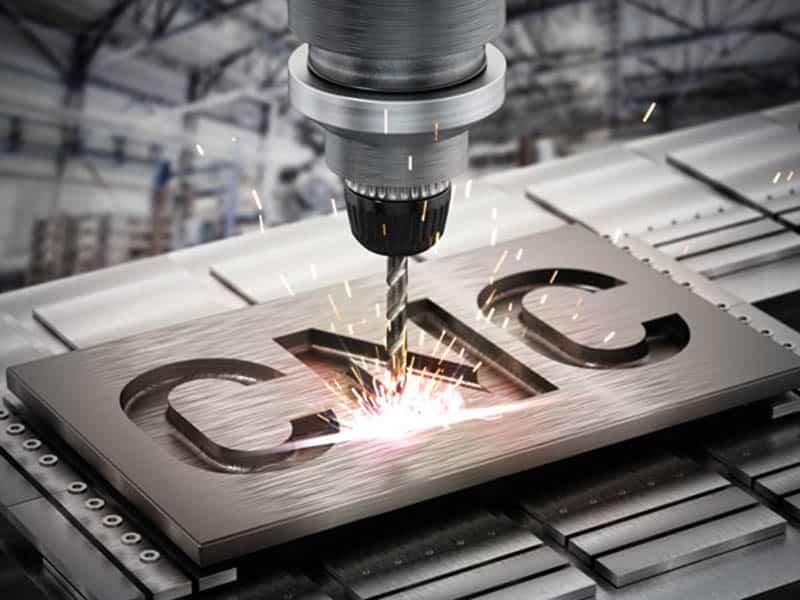
Metal CNC machining is a subtractive manufacturing process. It delivers accurate and repeatable metal parts for modern industries. As product requirements become more demanding in terms of tolerance, geometry, and performance, CNC-based processes continue to replace conventional manual machining methods. This article provides a structured overview of metal CNC machining.
What Is Metal CNC Machining?
Metal CNC machining refers to the process of using computer numerical control (CNC) systems to guide cutting tools that remove material from metal stock. The process relies on digital instructions generated from CAD (Computer-Aided Design) models, which are translated into machine-readable code (typically G-code).
Unlike manual machining, metal CNC machining operates with minimal human intervention once the program is set. The machine follows predefined toolpaths to cut, drill, mill, or turn metal materials into finished components with high dimensional accuracy.
How Metal CNC Machining Works?
The workflow of metal CNC machining generally follows a structured digital-to-physical process.
- Design Stage (CAD Modeling): The process begins with a 3D CAD model. Engineers define the geometry, dimensions, and tolerances of the part. This stage determines the final product’s functional and mechanical characteristics.
- Programming Stage (CAM): The CAD model is imported into CAM software, where toolpaths are generated. These toolpaths define how the cutting tool will move across the metal workpiece. The output is converted into G-code, which is interpreted by the CNC machine.
- Machining Stage: During machining, the CNC system controls the movement of tools along multiple axes.
- Post-Processing: After machining, parts may undergo secondary operations such as: deburring to remove sharp edges, surface finishing (polishing, anodizing, coating), and dimensional inspection using measurement tools or CMM systems.
Types of Metal CNC Machining Operations
Several cutting methods fall under metal CNC machining. Each serves to different geometries and applications.
CNC Milling
In CNC milling, the cutting tool rotates while the workpiece remains fixed. This method is used for producing flat surfaces, slots, pockets, and complex 3D shapes. This process works well for housings, brackets, and structural components. It is one of the most common forms of metal CNC machining.
CNC Turning
CNC turning involves rotating the workpiece while a stationary cutting tool removes material. It is primarily used for cylindrical components such as shafts, bushings, and threaded parts.
CNC Routing
CNC routing is typically associated with softer materials, but it can also be applied to certain metals such as aluminum. It is used for cutting profiles, engraving, and producing thin-sheet components. In metal CNC machining, routing is generally selected for applications requiring high-speed material removal with relatively low cutting forces.
CNC Cutting
CNC cutting includes processes such as laser cutting, plasma cutting, and waterjet cutting. These methods are often used for cutting metal sheets into defined shapes before secondary machining. It is a preprocessing operation in CNC machining.
Drilling and Related Operations
Drilling creates precise holes of various diameters and depths. Several secondary operations often follow drilling to achieve final specifications:
- Tapping: Cuts internal threads for screws and fasteners.
- Boring: Enlarges existing holes to precise diameters with improved roundness and straightness.
- Reaming: Finishes drilled holes to exact sizes and smoother surface finishes.
EDM (Electrical Discharge Machining)
EDM uses electrical sparks to erode hard metals. It suits intricate shapes in hardened tool steel where traditional cutters struggle.
Materials Used in Metal CNC Machining
Material selection plays a critical role in machining performance, cost, and final part functionality. Common options include:
Aluminum Alloys: Aluminum is lightweight, has good corrosion resistance, and is easy to machine. Used in aerospace brackets and automotive parts.
Stainless Steel: Stainless steel offers high strength and corrosion resistance. However, it is more difficult to machine compared to aluminum, requiring optimized cutting parameters in metal CNC machining processes.
Titanium Alloys: Titanium offers a high strength-to-weight ratio. It is more challenging to machine, often requiring slower cutting speeds and specialized tooling. It is applied in aircraft components and medical implants.
Copper and Brass: These materials offer conductivity and machinability. They are suitable for electrical connectors and heat sinks.
Tool Steels: Tool steels have high hardness and wear resistance. It is used for molds and dies.
Advantages of Metal CNC Machining
Metal CNC machining offers several key advantages that make it a preferred manufacturing method in precision industries.
- CNC systems can achieve very tight dimensional tolerances, often within micrometer ranges.
- Once a program is validated, metal CNC machining can produce identical parts consistently across large production batches.
- Multi-axis machining allows for the production of complex shapes that would be difficult or impossible with conventional machining methods.
- Automation reduces manual intervention and shortens production cycles. This improves efficiency, particularly in medium-volume production runs.
- Metal CNC machining supports a wide range of metals, allowing manufacturers to select materials based on performance and cost requirements.
Limitations of Metal CNC Machining
Despite its advantages, metal CNC machining has certain limitations that must be considered during process selection.
- As a subtractive process, CNC machining generates chips and waste material, which may increase overall material costs.
- Accurate machining depends on well-developed CNC programs. Skilled operators and engineers are required to optimize toolpaths and machining parameters.
- For very large production runs, processes such as stamping or casting may be more cost-effective than metal CNC machining.
Applications of Metal CNC Machining
Metal CNC machining is widely used across multiple industries due to its precision and flexibility.
Aerospace
- Structural parts
- Engine components
- Precision assemblies
Automotive
- Transmission parts
- Sensor mounts
- Housings produced
Medical
- Surgical instruments
- Implants
- Medical devices
Prototyping and Product Development
- Injection Mold
- Custom part
Metal CNC Machining vs Other Manufacturing Methods
When choosing a production method, customers often compare key factors such as precision, cost, speed, and suitability for different volumes. The table below compares metal CNC machining with common alternatives.
| Aspect | Metal CNC Machining | Casting | 3D Printing (Metal) | Stamping |
|---|---|---|---|---|
| Dimensional Accuracy | Excellent (±0.005 mm possible) | Moderate (requires secondary machining) | Good for complex shapes, but less consistent tolerances | High for thin sheet parts, limited for complex geometries |
| Surface Finish | Good surface finish, can be improved with post-processing | Rough (needs finishing) | Moderate, often requires finishing | Good for formed surfaces, minimal finishing needed |
| Material Properties | Excellent, retains full material strength | May have internal defects such as porosity | Material properties vary depending on process | Good for sheet metals, limited to specific thickness ranges |
| Design Complexity | High (complex geometries in one setup) | Limited by mold design | Very high | Limited to simpler geometries |
| Production Volume Suitability | Best for low to medium volumes | Suitable for medium to high volumes | Best for low volume and prototyping | Ideal for very high-volume production |
| Lead Time | Short to medium (days to weeks) | Long (tooling takes weeks) | Very short for prototypes | Long initial setup |
| Material Waste | Higher | Lower | Minimal waste | Low waste for sheet materials |
| Cost Efficiency | Cost-effective for lower volumes | Economical at scale | Higher cost per part | Very cost-effective at high volumes |
| Typical Applications | Precision parts, prototypes, functional components | Engine blocks, housings | Complex prototypes, lightweight structures | Automotive panels, brackets, sheet metal parts |
Conclusion
Metal CNC machining provides a proven method for creating precise metal parts across many industries. It supports both prototypes and production volumes. Welcome to contact us and get a professional solution for your project.
Start A New Project Right Now!