When producing thousands—or even millions—of plastic parts, efficiency and consistency become critical. High volume plastic injection molding is the manufacturing solution that makes this possible. By combining durable molds, automated machines, and optimized processes, manufacturers can create large-scale production runs with tight tolerances, minimal waste, and consistent quality. Even if you’ve never stepped into a factory, understanding high volume molding gives you insight into how everyday products—from electronics to automotive components—are reliably made in massive quantities.
If you are not familiar with injection molding, you can learn more in our article on Injection Molding Basics.
What Is High Volume Plastic Injection Molding?
High volume plastic injection molding is a specialized manufacturing process designed for producing large quantities of identical plastic parts efficiently and consistently. Unlike short-run or prototype molding, which may use simpler molds and slower cycle times, high volume production relies on robust multi-cavity molds, precise temperature and pressure control, and automated handling systems.
The process ensures each cycle produces parts that meet tight dimensional tolerances and surface quality requirements, even after thousands of repetitions. It also allows for integration of advanced mold features, such as hot runner systems, conformal cooling channels, and ejector mechanisms, which improve cycle efficiency and maintain uniformity across all parts.
In short, high volume molding is the method manufacturers use when speed, repeatability, and long-term durability are essential, turning raw plastic into finished components at industrial scale without compromising precision.
Benefits of High Volume Injection Molding
High volume plastic injection molding delivers more than just large quantities of parts. One of its main advantages is the significant reduction in per-unit cost: although the initial investment in durable molds is higher, producing thousands or millions of parts spreads this cost over the entire production run, making each component more economical. The process also ensures reliable consistency, as automated machines and precise process controls maintain the same dimensional accuracy and surface quality for every cycle, greatly reducing defects and rework.
Another key benefit is faster production cycles. Optimized mold design, efficient cooling systems, and automated ejection allow each part to be formed quickly, enabling manufacturers to meet tight deadlines. Moreover, high volume setups allow careful control of material flow and processing parameters, minimizing waste while improving part stability. The process is also highly scalable: once a high volume system is in place, production can be increased without major modifications, making it ideal for industries with steady or growing demand.
How Is High Volume Molding Different than Standard Runs?
High volume plastic injection molding stands apart from standard or low-volume production in several critical ways. These differences are not just about quantity—they affect mold design, process control, automation, and long-term production strategy.
Mold Design and Durability
One of the most significant differences lies in the molds themselves. High volume production relies on multi-cavity or stack molds built from wear-resistant steels or alloys. These molds are engineered to withstand tens of thousands, or even millions, of injection cycles without losing dimensional accuracy or surface quality. Standard molds, by contrast, are simpler, often single-cavity, and intended for smaller runs. While sufficient for prototypes or small batches, they are not designed for the repeated stresses of large-scale production.
High volume molds may also include advanced features such as hot runner systems, which maintain consistent melt flow, and conformal cooling channels, which optimize cooling across all cavities. These design elements reduce cycle time and maintain uniformity, something rarely required for standard molds.
Process Control and Precision
In high volume molding, process parameters are carefully monitored and controlled. Injection pressure, melt temperature, cycle speed, and cooling times are continuously adjusted to ensure that every part meets tight tolerances and surface quality standards. Small deviations in low-volume runs may be acceptable, but in high volume production, even minor inconsistencies can lead to thousands of defective parts.
Additionally, high volume setups often incorporate inline quality monitoring. Sensors and inspection systems can detect defects immediately, allowing adjustments in real time. Standard runs usually rely on manual inspection, which is slower and less consistent.
Automation and Handling
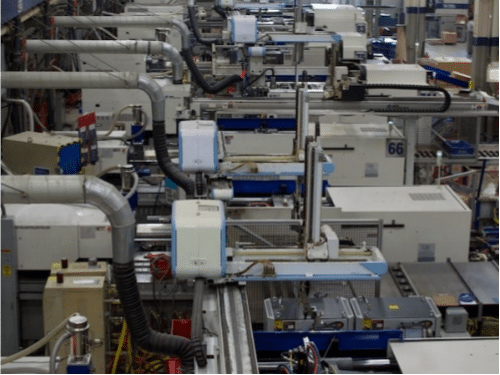
Another defining feature of high volume molding is automation. Robots and automated conveyors handle part removal, sorting, and packaging, reducing human error and labor costs. In contrast, standard runs are typically more manual, with operators responsible for part ejection, inspection, and handling. Automation in high volume production also enables continuous operation, which is essential to meet tight deadlines for thousands of parts.
Maintenance and Longevity
High volume molds are engineered for long-term durability. Surfaces are hardened, ejector pins are reinforced, and the overall construction anticipates repeated wear. Regular maintenance schedules are integrated into production planning to maintain mold integrity over years of operation. Standard molds, which experience fewer cycles, often require less robust design and less frequent maintenance, but they cannot support the same level of continuous output without risking defects or premature wear.
Applications of High Volume Plastic Injection Molding
High volume injection molding is widely used in industries where large quantities of consistent parts are essential.
Consumer Electronics
Smartphone and tablet casings, buttons, and connectors are produced in high volumes with precise tolerances and consistent surface quality, ensuring reliability and aesthetic appeal.
Automotive Components
Interior trims, clips, and dashboard panels require durability and tight dimensions, which high volume molds and optimized cooling channels can consistently deliver.
Packaging Industry
Bottle caps, closures, and containers are manufactured at massive scale, with accurate fit and minimal defects thanks to automated handling and multi-cavity molds.
Medical Devices
Disposable syringes, housings, and other medical components demand precision and sterilizability, achieved efficiently through high volume production.
Industrial Components
Gears, fasteners, and functional housings benefit from uniformity and repeatability, reducing assembly issues and ensuring long-term reliability.
Choosing the Right Manufacturer for High-Volume Injection Molding
Selecting a reliable partner for high-volume injection molding is crucial for ensuring quality, consistency, and efficiency over hundreds of thousands—or even millions—of cycles. Here’s what to consider:
Experience with Large-Scale Production
A manufacturer with extensive experience understands the challenges of high-volume production, such as controlling part warpage, avoiding short shots, and maintaining tight dimensional tolerances. Experienced teams can optimize cycle times and mold maintenance schedules to reduce defects and downtime.
Advanced Equipment and Technology
High-volume injection molding requires precision machinery capable of consistent operation. Modern multi-tonnage injection machines, automated material feeding, temperature-controlled molds, and in-line quality inspection systems help maintain part uniformity and minimize human error.
Comprehensive, One-Stop Services
A one-stop manufacturer can handle everything from mold design and prototyping to post-processing and assembly. This reduces lead times, minimizes communication gaps, and ensures that each stage of production meets exact specifications.
Material Versatility and Controlled Handling
High-volume projects often use multiple materials, including plastics, rubber, and metal inserts. Working with a single manufacturer that can process different materials in dedicated lines avoids cross-contamination and ensures consistent material properties. Proper handling prevents degradation, maintains color consistency, and guarantees the mechanical performance of each batch.
Conclusion
By now, you’ve learned what high volume plastic injection molding is, its key benefits, and how it differs from standard runs. You’ve also seen when it’s the right choice and where it’s commonly applied. For anyone looking to produce large quantities of precise, consistent parts efficiently, this process is a game-changer.
At Zhongde, we bring decades of expertise in high-volume injection molding, combined with state-of-the-art machinery and a one-stop service model covering plastics, rubber, and metal components. Our approach ensures reliable, high-quality production from prototyping to mass manufacturing. For projects that require precision, efficiency, and scalability, partnering with Zhongde provides the confidence and support to bring your designs to life successfully.
Start A New Project Right Now!