Crack defects in injection molding represent a frequent issue in the production and assembly of plastic parts. This issue not only affects the appearance and functionality of the final product but can also lead to increased production costs and delays. It is a primary concern for buyers.
Common Locations for Crack Defects in Injection Molded Parts
Injection molding cracks often appear during the manufacturing process or later stages. Crack defects in injection molding are rarely isolated occurrences. They typically result from a combination of underlying manufacturing flaws, applied stresses, and environmental conditions during use.
Injection molding cracks tend to occur in specific areas of plastic parts where stress concentrations are highest. These locations are influenced by part geometry, material flow during molding, and design features.
Sharp Corners and Thickness Transitions
Here, the material experiences higher shear forces during filling, which can initiate small fractures that grow over time.
Rib Roots and Boss Bases
The junction between ribs/bosses and the nominal wall is a classic location for crack defects in injection molding. Differential cooling rates between thick and thin sections generate tensile stresses on the surface.
Hole Edges and Perforations
Post-molded drilling or directly molded holes create stress risers. Thin walls around holes combined with residual molding stress often result in radial or circumferential cracks.
Weld Lines and Knit Lines
Weld lines, formed where two flow fronts meet in multi-gate molds, represent weak points where cracks initiate under load.
Gate Areas (Especially in Transparent Materials)
High shear at small or pin-point gates causes molecular chain scission and frozen-in stress. In PC, PMMA, and PS, gate-area cracking is one of the most common injection molding cracks.
Snap-Fit and Cantilever Hook Roots
The root thickness of snaps is often only 50-60% of the base wall. Bending during assembly releases residual stress, producing cracks at the exact root radius.
Self-Tapping Screw Bosses
Hoop stress from screw insertion combines with molding stress. Cracks typically radiate outward from the boss inner diameter or appear as longitudinal splits.
Ejector Pin Marks and Push-Out Areas
Excessive ejection force or insufficient draft leaves visible stress-whitened circles that later develop into star-shaped or linear cracks.
Metal Insert Perimeters
Differential thermal contraction between plastic and metal inserts creates annular tensile stress. Cracks form concentric rings around inserts if insert temperature or preheat is not controlled.
Defect Types Directly Related to Cracking
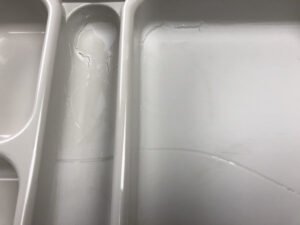
Many common molding defects are not just cosmetic issues, they weaken the part and greatly increase the probability of cracking.
- Internal and residual stress: Even if the surface looks perfect, the part can contain high internal stresses from uneven cooling, excessive packing pressure, or improper demolding.
- Weld lines and flow marks: Poorly fused weld lines or regions with flow marks often indicate incomplete molecular entanglement or local weakness. Under tensile or bending loads, cracks often initiate in these weak regions, especially if they coincide with geometric stress concentrators.
- Silver streaks and splay: Silvering, splay, or micro‑voids caused by moisture, air entrapment, or degraded resin can lead to local brittle zones.
- Gate blush and gate stress marks: Over‑packing or high shear at the gate can leave the region brittle and stressed.
- De‑molding damage and ejector marks: Poor ejection design, insufficient draft, or rough mold surfaces can cause micro‑cracks, whitening, or gouges during ejection.
Causes of Cracking in Injection Molded Parts
The causes of cracking in plastic injection molded parts are multifactorial. The most common reasons include:
Material Related
Material-related causes include inadequate drying, leading to moisture absorption and hydrolysis in hygroscopic resins like nylon or PC. This results in material brittle parts prone to injection molding cracks. Using recycled materials with inconsistent properties can also introduce impurities that act as crack initiators.
Process Parameters Related
- Low mold temperatures cause rapid skin formation, trapping internal stresses that manifest as cracks.
- Insufficient packing pressure fails to compensate for shrinkage, leading to voids and stress concentrations where a crack in a plastic part can form.
- Uneven cooling can lead to internal stresses within the part, which, if not addressed, will lead to cracking.
- Excessive injection pressures can cause the material to flow unevenly, leading to stress concentrations that result in cracks.
- Too low an injection pressure may lead to incomplete filling, creating voids and weak spots that are susceptible to cracking.
Overheating
If the material is exposed to excessive heat during molding, it can degrade or become overly brittle. This makes it more likely to crack under pressure or during use. Overheating can also result from incorrect barrel temperature settings or extended residence times in the mold.
Mold Design Flaws
Poor mold design, such as improper gate placement, inadequate venting, or poorly designed cooling channels, can lead to uneven material flow and cooling, which in turn contributes to cracking.
Why Cracking Is Most Common in Assembly?
Injection molding cracks are often reported during assembly rather than immediately after molding. This occurs because assembly introduces additional stresses that reveal latent defects. In assembly, operations like screwing, snapping, or welding apply forces that exceed the material’s yield strength in weakened areas.
A specific case illustrates this: A manufacturer produced PC housings for electronic devices. The parts passed initial inspections, showing no visible defects. During assembly, ultrasonic welding was used to join halves. Within days, cracks appeared at weld interfaces, affecting 30% of the batch. Investigation revealed that high injection speeds had caused excessive molecular orientation near the gates, combined with inadequate annealing. The welding heat and vibration triggered crack propagation.
Effective Strategies to Prevent and Solve Crack Problems
Preventing crack defects in injection molding requires a multifaceted approach
Material Handling: Dry resins thoroughly to specified moisture levels, using dehumidifiers for consistency. Limit recycled content and verify compatibility through testing.
Optimize mold design: Incorporate generous radii at corners and bosses. Use side gates or fan gates to reduce shear. Ensure uniform wall thickness to minimize differential shrinkage.
Controlling Process Parameters: Carefully monitor and adjust injection molding parameters such as temperature, pressure, and cooling rates. Extending packing times to fully compensate for shrinkage, and controlling injection speeds to avoid degradation.
Improving Cooling: Implement a more controlled and uniform cooling process to prevent thermal gradients. Such as conformal cooling or using multiple cooling zones.
Testing: Conduct stress-relief annealing for high-stress parts. Perform impact and tensile tests on samples. Use mold flow simulations like Moldflow to predict stress distributions and adjust designs accordingly.
Partner Reliable Manufacturer to Avoid Cracking
Cracking in injection molded parts can be a significant issue, but it’s one that can be minimized with the right approach. An experienced manufacturer with advanced technological capabilities and a strong focus on quality assurance is key to ensuring that cracks are avoided throughout the production process. Zhongde provides professional plastic injection molding service with systematic approaches to avoid cracking issues in molded parts.