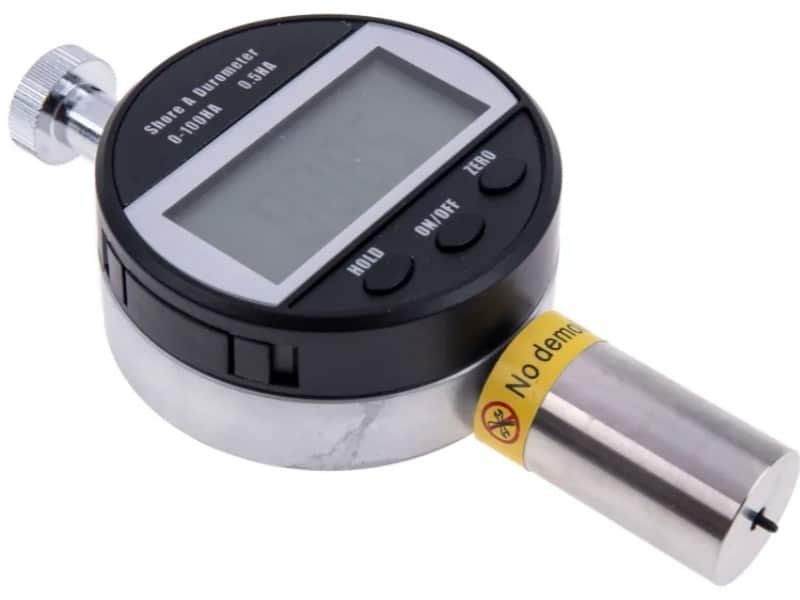
Rubber hardness is a key property that affects how rubber materials perform in different applications. It influences flexibility, sealing ability, wear resistance, and overall durability.
For manufacturers and buyers of custom rubber parts, understanding rubber hardness helps ensure the material matches functional requirements and working conditions.
What Is Rubber Hardness?
Rubber hardness refers to the resistance of a rubber material to indentation. In simple terms, it describes how soft or hard a rubber compound feels when pressure is applied.
Unlike metals, rubber does not have a fixed hardness value. Its hardness depends on formulation, additives, and processing conditions.
Factors Affecting Rubber Hardness
Several factors influence the hardness of rubber materials:
Material formulation: The ratio of base polymer, fillers, and plasticizers directly affects hardness. More fillers typically increase hardness.
Crosslinking (curing level): Higher crosslink density generally leads to higher hardness and reduced elasticity.
Temperature: Rubber becomes softer at higher temperatures and harder at lower temperatures.
Aging and environmental exposure: UV, oxidation, and chemicals can change hardness over time.
Processing conditions: Molding temperature and curing time can influence the final hardness of the product.
Why Is Measuring Rubber Hardness Important?
Measuring rubber hardness is essential because it directly affects product performance.
- It helps ensure proper sealing in gaskets and O-rings
- It affects flexibility and user interaction in soft components
- It influences wear resistance and load-bearing capability
- It ensures consistency across production batches
Without proper hardness control, products may fail in function or have inconsistent quality.
What Is Rubber Shore Hardness?
Rubber hardness is commonly measured using the Shore hardness system, which is based on the depth of indentation under a specific force.
The Shore hardness scale was developed by Albert F. Shore in the early 20th century to provide a consistent and practical method for measuring the hardness of rubber and similar materials. His design led to the development of the durometer, which is still widely used today.
The two most commonly used scales for rubber are Shore A and Shore D, each designed for different hardness ranges and material types.
Shore A
Shore A is used for soft to medium-hard rubber materials. The scale usually ranges from very soft (around 10 Shore A) to semi-rigid (around 90 Shore A).
For most industrial applications, commonly used Shore A hardness values include:
- 40 Shore A
- 50 Shore A
- 60 Shore A
- 65 Shore A
- 70 Shore A
- 75 Shore A
- 80 Shore A
- 82 Shore A
- 88 Shore A
- 90 Shore A
These values represent typical ranges used in different applications, where lower values are generally selected for flexibility and sealing performance, while higher values are used for improved strength and wear resistance.
Shore D
Shore D is used for harder rubber materials and semi-rigid plastics. The scale typically applies to materials that are too hard to be accurately measured using Shore A.
For most industrial applications, commonly used Shore D hardness values include:
- 40 Shore D
- 50 Shore D
- 60 Shore D
- 65 Shore D
- 70 Shore D
- 75 Shore D
- 80 Shore D
These values are generally selected for applications requiring higher stiffness, dimensional stability, and wear resistance, such as rollers, structural components, and rigid housings.
Rubber Shore Hardness Range and Classfication
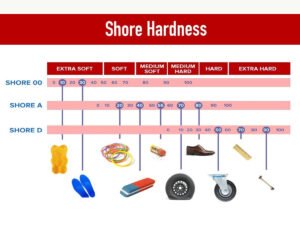
Rubber materials are commonly classified according to their Shore hardness values. This classification helps engineers and buyers quickly match material flexibility and stiffness with specific application requirements.
In practical use, rubber hardness is not treated as a single value but divided into several working ranges:
Very soft rubber (Shore 00 range, around 10–60 Shore 00)
This range is used for extremely soft elastomeric materials such as gels, ultra-soft seals, cushioning pads, and medical or ergonomic components. Shore 00 is applied when materials are too soft to be measured accurately on the Shore A scale.
Soft rubber (around 10–40 Shore A)
This range is used for highly flexible applications where compression and sealing performance are important. Typical products include soft seals, cushioning pads, and low-load vibration damping parts.
Medium rubber (around 40–70 Shore A)
This is the most commonly used range in industrial rubber products. It offers a balance between flexibility and durability and is widely used in O-rings, gaskets, general sealing components, and vibration isolators.
Hard rubber (around 70–90 Shore A)
Materials in this range provide higher wear resistance and better structural stability. They are often used in rollers, industrial pads, and components exposed to mechanical stress or repeated loading.
Very hard / semi-rigid materials (Shore D range)
When rubber-like materials exceed the Shore A measurement range, Shore D is used. This range applies to harder elastomers and semi-rigid components that require high stiffness, dimensional stability, and mechanical strength.
How to Measure Rubber Hardness
Rubber hardness is typically measured using a device called a durometer. The measurement is based on how deeply a standardized indenter penetrates the rubber surface under a controlled force. To ensure consistent and reliable results, the testing process must follow defined conditions.
- Sample preparation: The test sample should have a flat, clean, and smooth surface. It must also be thick enough to prevent the hardness reading from being influenced by the supporting surface underneath. Contamination such as dust, oil, or release agents should be removed before testing.
- Selecting the correct scale: Before measurement, the appropriate scale (Shore A or Shore D) must be selected based on material hardness. Using the wrong scale may result in inaccurate or non-comparable values.
- Positioning the durometer: The durometer should be placed perpendicular to the surface of the sample. Any tilt or uneven contact can affect the reading and reduce accuracy.
- Applying consistent force: The indenter is pressed into the material with a steady and controlled force. The measurement is usually taken after a short dwell time to allow the reading to stabilize.
- Reading the result: The hardness value is displayed on the scale of the durometer, typically ranging from 0 to 100. Multiple measurements are often taken at different points to ensure consistency.
- Recording and averaging results: To improve accuracy, several readings are taken across the sample surface, and the average value is recorded as the final hardness result.
How to Choose Between Shore A and Shore D
The choice depends mainly on the hardness range of the material and its application.
Use Shore A when the material is flexible and can be easily indented, such as seals or soft rubber components.
Use Shore D when the material is harder and resists indentation, such as structural rubber parts or semi-rigid components.
In general, if the material feels soft or elastic, Shore A is appropriate. If it feels rigid or tough, Shore D is more suitable.
Rubber Hardness in Common Applications
Rubber hardness plays a key role in determining product performance across different industries. The required hardness level depends on mechanical load, sealing requirements, and working environment.
Automotive Industry
Rubber components such as engine mounts, bushings, and seals typically use 50–80 Shore A materials. Softer grades are used for vibration damping, while harder grades are used for load-bearing parts exposed to stress and heat.
Industrial Equipment
Rollers, pads, and protective components often require 70–90 Shore A rubber to ensure wear resistance and long service life under continuous operation.
Sealing Systems
O-rings and gaskets used in hydraulic and pneumatic systems generally fall within the 50–70 Shore A range. The selected hardness ensures proper compression and long-term sealing performance.
Consumer Products
Handheld tools, grips, and wearable components usually use softer rubber materials (40–60 Shore A) to improve comfort, flexibility, and user experience.
Heavy-Duty / Engineering Applications
When higher stiffness is required, semi-rigid elastomers in the Shore D range are used for structural or load-bearing components.
Conclusion
Accurate understanding of rubber hardness helps ensure better material selection and product performance across different applications. Besides the commonly used Shore hardness system, international standards such as IRHD (International Rubber Hardness Degree) are also applied in certain industries for more consistent measurement.
If you are selecting rubber materials for a custom project, you can contact Zhongde for technical support and manufacturing guidance.